
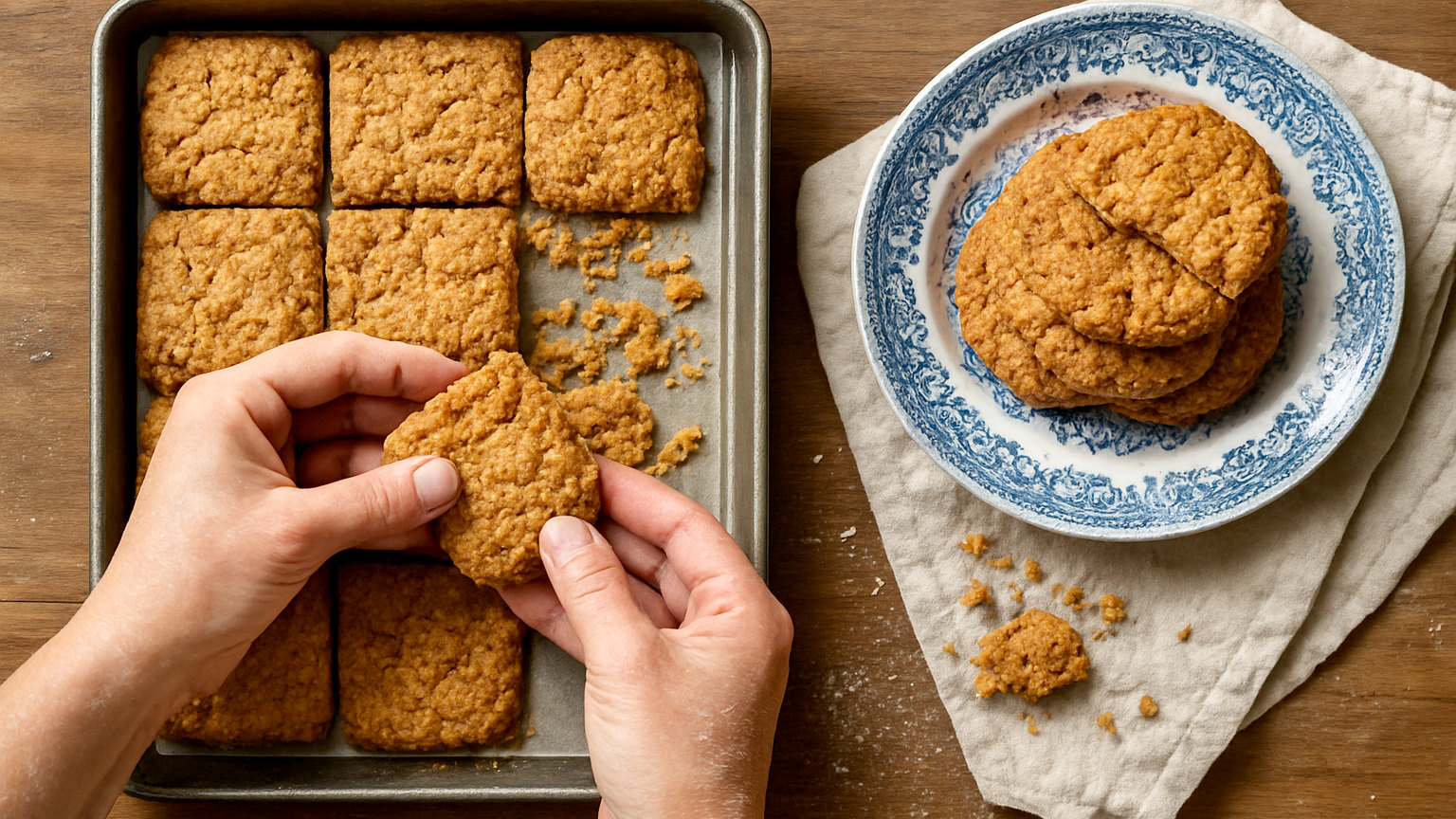
Anzac biscuits are chewy oat and coconut biscuits held together with melted butter and golden syrup, with bicarbonate of soda dissolved in boiling water to lift them. They contain no eggs at all, which is central to their history, and they keep for weeks. They are a fixture of Australian and New Zealand baking and are made every year around Anzac Day on 25 April.
Where do they come from?
The biscuits are linked to the Australian and New Zealand Army Corps of the First World War, and to the women who baked and sent parcels to soldiers serving overseas. Because they contain no eggs, they kept well on long sea voyages. Whether the biscuits sent at the time were exactly these is debated by food historians, but the association is long-standing and deeply felt in both countries.
Why are they always called biscuits?
In Australia, the word Anzac is protected by law, and its use on products requires permission. One well-known condition is that the biscuits must be called Anzac biscuits rather than cookies, and the traditional recipe should not be substantially altered. Home bakers are not affected, but it explains why you will never see them sold under another name.
What ingredients do you need?
Makes about 20 biscuits.
- 100g porridge oats
- 100g desiccated coconut
- 150g plain flour
- 150g caster sugar
- 125g unsalted butter
- 2 tbsp golden syrup
- 1 tsp bicarbonate of soda
- 2 tbsp boiling water
How do you make Anzac biscuits?
- Heat the oven to 160°C (140°C fan), gas 3. Line two baking trays with baking paper.
- Mix the porridge oats, desiccated coconut, plain flour and caster sugar in a large bowl.
- Melt the butter and golden syrup together in a pan over a low heat.
- Dissolve the bicarbonate of soda in the boiling water and stir it into the melted butter. It will foam up.
- Pour into the dry ingredients and mix well.
- Roll into walnut-sized balls and place well apart on the trays, then flatten each one slightly.
- Bake for 12 to 15 minutes for chewy biscuits, or 18 minutes for crisp ones.
- Leave on the tray for 10 minutes to firm up, then transfer to a wire rack.
Watch them closely near the end: the golden syrup means they go from golden to too dark quickly, and a few minutes decides whether they are chewy or crunchy.
Why is there no egg?
The absence of egg is the defining feature. Eggs make baked goods spoil faster, so an egg-free biscuit kept far better in the days before refrigeration and could survive weeks at sea. The bicarbonate of soda and boiling water provide the lift instead, and the golden syrup binds the mixture together.
How do you make them chewy or crisp?
Baking time is the main control. Take them out at 12 to 15 minutes, while they still look slightly soft in the middle, and they will set chewy as they cool. Leave them to 18 minutes, until evenly deep golden, and they will be crisp all the way through. Flattening them more before baking also gives a crisper result.
Why dissolve the bicarbonate of soda in water?
Dissolving it first ensures it disperses evenly through the mixture rather than leaving pockets that taste soapy. Adding it to the hot butter and syrup starts the reaction immediately, which is why the mixture foams. Work fairly quickly once it is in, so the lift is not lost before the biscuits reach the oven.
Can you add other ingredients?
Traditionally they contain nothing more than the ingredients above, and in Australia there are limits on how far a commercial version can stray. At home, some people add chopped nuts, dried fruit or chocolate chips. They are good, though a purist would point out that they are then no longer quite Anzac biscuits.
How long do they keep?
They keep for up to two weeks in an airtight tin, which is entirely the point of them. Chewy ones gradually firm up and crisp ones soften slightly, so store them separately from other biscuits. They freeze for three months, baked or as rolled balls of dough.


