
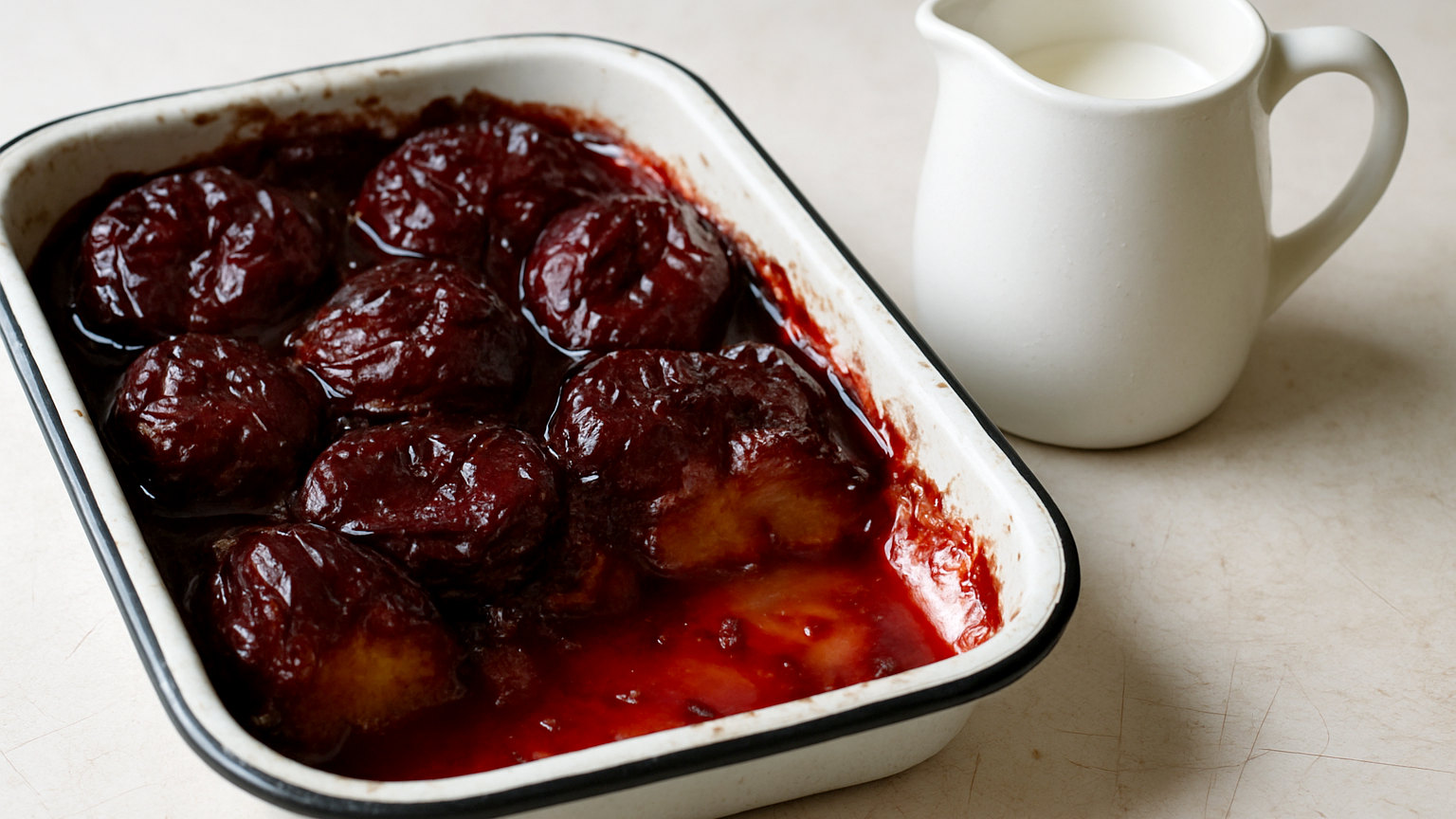
Roasted plums are halved, scattered with honey and a little vanilla and put in a hot oven until they slump into a pool of their own deep red syrup. It takes twenty minutes, requires no skill whatsoever, and turns ordinary supermarket plums into something worth serving to guests. They are equally good warm or cold.
What do you need?
Serves 6.
- 12 ripe plums, halved and stoned
- 4 tbsp runny honey
- 1 vanilla pod, split, or 1 tsp vanilla bean paste
- Pared zest of 1 orange
- 2 star anise, optional
- 2 tbsp water
- A pinch of fine salt
How do you make them?
- Heat the oven to 200°C (180°C fan), gas 6.
- Arrange the plum halves cut side up in a single layer in a baking dish, packed fairly snugly.
- Drizzle over the honey and scatter with the orange zest, star anise and salt.
- Tuck the split vanilla pod among the fruit.
- Pour the water into the base of the dish.
- Roast for 20 to 25 minutes, until the plums are soft and collapsing and the juices have turned syrupy.
- Spoon the syrup over the fruit before serving.
Roast them cut side up: face down, the cut surface sits in the juices and steams rather than caramelising, and you lose the concentrated edges that make the dish.
Which plums should you use?
Any ripe plum works. Victoria plums, in season in Britain from August to September, are the classic choice and have the best balance of sweetness and acidity. Damsons are much sharper and need more honey. Dark-skinned varieties give a deeper red syrup, which looks better.
How ripe should they be?
Ripe but still firm. They should give slightly when pressed and smell fragrant at the stalk end. Very soft plums collapse entirely into the syrup within ten minutes, which is not a disaster but gives more of a compote than distinct halves. Underripe plums stay sour and firm.
Why add water to the dish?
A couple of tablespoons stops the honey catching and burning on the base of the dish before the plums release their own juices. It evaporates during roasting and becomes part of the syrup. Without it, the sugars can scorch in the first few minutes.
Can you use other fruit?
Yes. Apricots, peaches, nectarines and figs all roast beautifully in the same way, with figs needing only 15 minutes. Rhubarb works too, cut into lengths, though it needs less time and more honey. The method suits any stone fruit that is slightly firmer than perfectly ripe.
What can you add to them?
Star anise, cinnamon, cardamom and bay all suit plums. A splash of port, marsala or red wine in place of the water gives a richer syrup, though the alcohol will not entirely cook off. A scattering of flaked almonds in the last five minutes adds texture.
What should you serve with them?
Thick Greek yoghurt, clotted cream, crème fraîche, vanilla ice cream or a spoonful of mascarpone. They are also very good on porridge or with rice pudding, and cold with granola for breakfast. The syrup is the best part, so make sure each portion gets some.
How long do they keep?
They keep for four days in the fridge in their syrup and are excellent cold. They freeze for three months, which makes this a good way to deal with a glut of plums. Reheat gently or eat straight from the fridge.
Why does the honey work better than sugar?
Honey caramelises at a lower temperature than granulated sugar and it is already liquid, so it coats the fruit evenly and starts browning within minutes. It also brings its own floral flavour. Maple syrup does the same job, and caster sugar works but needs a few extra minutes.
Can you cook them on a barbecue?
Yes, wrapped in a foil parcel with the honey and spices, for about 15 minutes on the cooler part of the grill. The plums steam rather than roast, so they will be softer and paler, but the flavour is excellent and the syrup collects neatly in the foil.


