
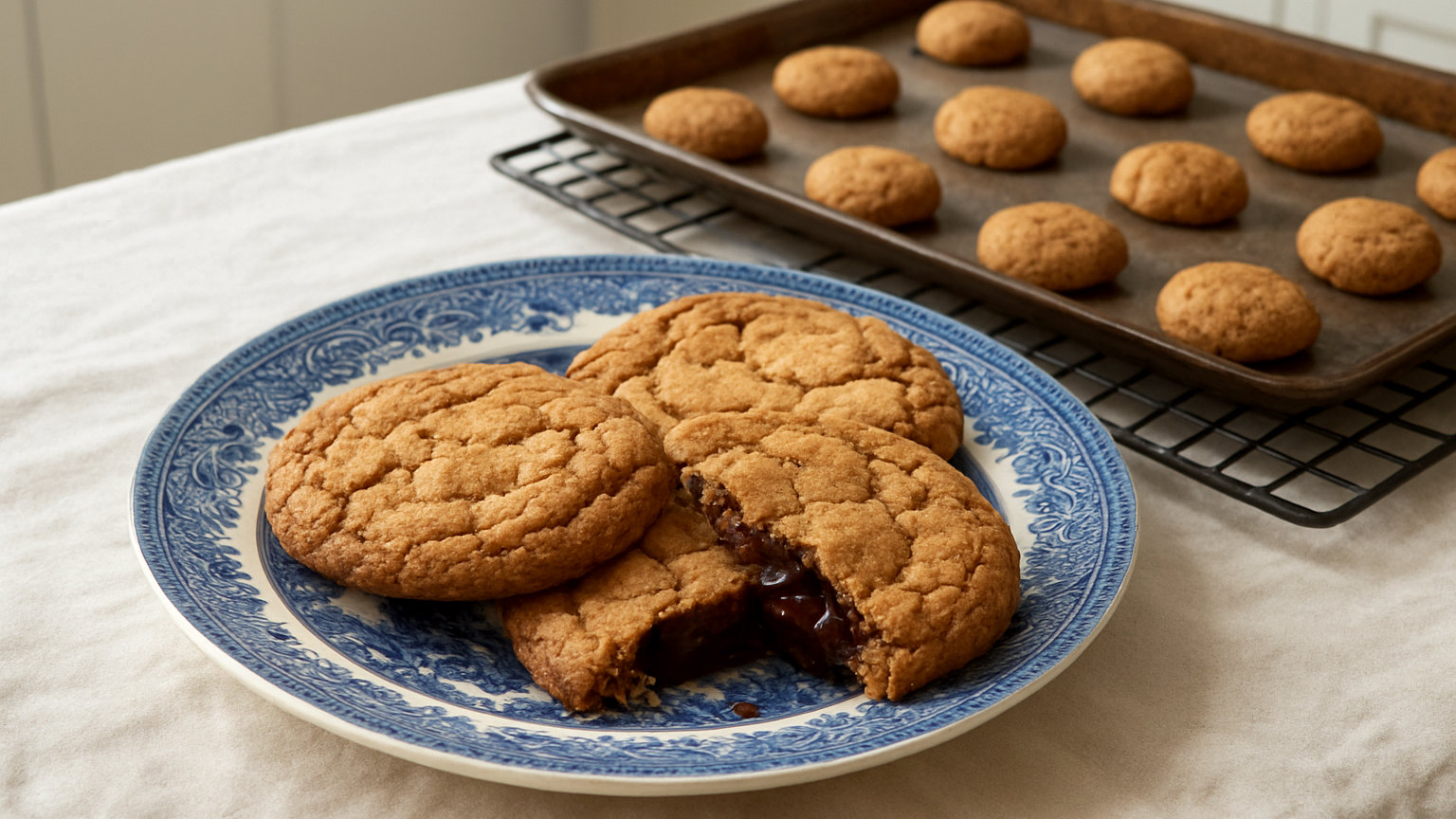
Giant bakery-style cookies are thick, craggy and around 120g each, with set edges and a soft, almost molten middle. They are not simply a normal cookie made bigger. Getting that gooey centre needs a colder dough, a hotter oven and a shorter bake, so the outside sets before the inside has time to dry out. The result is the kind of cookie sold warm in city bakeries.
What makes a bakery cookie different?
Three things. The portion is much larger, usually 100g to 120g of dough, which creates enough depth for a soft centre. The dough is very cold, often chilled overnight, so it spreads slowly. And it is baked hot and briefly, which sets the outside quickly. Together these give the contrast between crisp edge and gooey middle.
What ingredients do you need?
Makes 8 giant cookies.
- 200g unsalted butter, softened
- 200g light brown soft sugar
- 100g caster sugar
- 1 large egg plus 1 yolk
- 2 tsp vanilla extract
- 375g plain flour
- 1 tsp bicarbonate of soda
- 1 tsp cornflour
- ¾ tsp fine salt
- 300g dark chocolate, chopped into large chunks
How do you make giant cookies?
- Beat the butter and both sugars together for two minutes, until creamy but not pale.
- Beat in the egg, yolk and vanilla.
- Sift in the flour, bicarbonate of soda, cornflour and salt, and mix until just combined.
- Fold in the chocolate chunks, keeping some large.
- Divide into eight pieces of about 120g and roll into tall balls rather than flat discs.
- Chill on a tray for at least four hours, or overnight.
- Heat the oven to 200°C (180°C fan), gas 6, and line two baking trays.
- Bake four at a time, well apart, for 11 to 13 minutes, until the edges are golden and set but the centres look pale and underdone.
- Leave on the tray for 15 minutes to finish setting, then move carefully to a rack.
Shape them tall, not flat: a tall ball of dough spreads outwards more slowly, so the middle stays thick and gooey. Flattened dough bakes through evenly and loses the molten centre.
Why bake at a higher temperature?
A hotter oven sets the outside of a large cookie quickly, before the heat reaches the middle. At a normal 180°C, a 120g cookie takes long enough that the centre dries out by the time the edges are golden. At 200°C the edges set fast and the bake is short, which protects the soft middle.
What does the cornflour do?
A teaspoon of cornflour softens the structure slightly and helps keep the centre tender. It is a common addition in bakery-style recipes and gives a subtly softer, thicker cookie. It is not essential, but it makes a noticeable difference in a cookie this size.
Why must the dough be so cold?
Cold butter melts more slowly, so the cookie holds its height for longer in the oven. Four hours is the minimum; overnight is better, and 24 to 36 hours improves the flavour as the flour hydrates fully. Baking straight from the fridge, not from room temperature, is important.
How do you get the craggy tops?
Roll the balls roughly rather than smoothing them, and press a few extra chocolate chunks into the top before baking. Some bakers tear each ball in half and press it back together with the rough side up. The uneven surface bakes into the ridged, craggy look that bakery cookies have.
How long do they keep?
They are at their best warm, within an hour of baking. They keep for three days in an airtight tin and can be refreshed for three minutes in a hot oven. The raw dough balls freeze for three months and bake from frozen at the same temperature with an extra three minutes.
Can you make them smaller?
Yes, though they become ordinary cookies rather than bakery-style ones. At 60g each, bake for 10 to 12 minutes at 180°C (160°C fan) instead. The high oven temperature suits large cookies specifically, because it protects the centre during a long enough bake to set the edges.


