
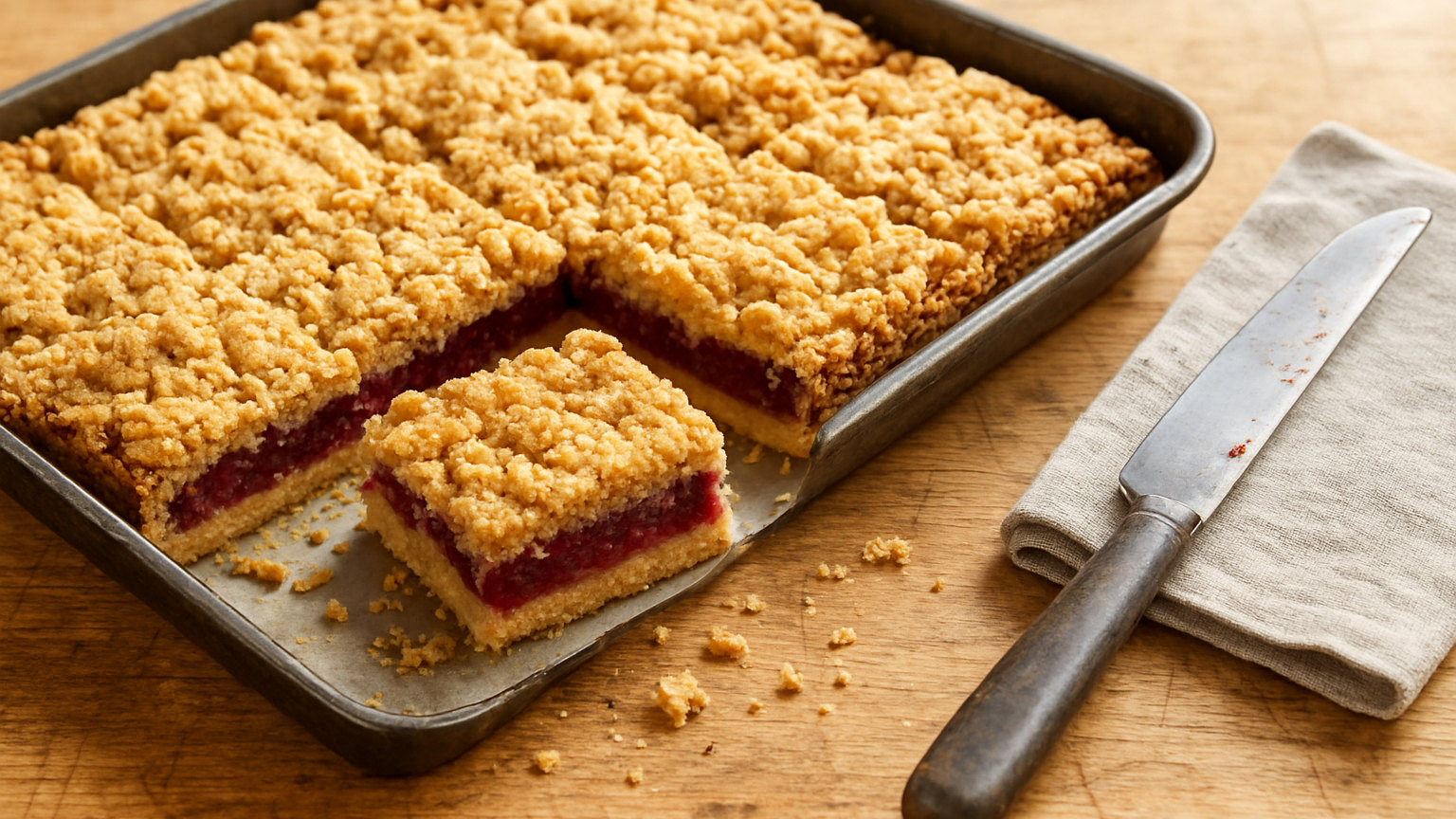
A raspberry crumble slice has three layers baked together: a buttery shortbread base, a sharp raspberry layer and a crumbly oat topping that turns golden in the oven. It tastes like a raspberry crumble that you can pick up and eat with your hands, and it is far easier than it looks because the base and the topping come from the same mixture.
What ingredients do you need?
Makes 16 squares.
For the base and topping
- 300g plain flour
- 150g porridge oats
- 200g light brown soft sugar
- 1 tsp baking powder
- A pinch of fine salt
- 250g unsalted butter, melted
For the raspberry layer
- 400g raspberries, fresh or frozen
- 75g caster sugar
- 2 tbsp cornflour
- 1 tbsp lemon juice
- 2 tbsp demerara sugar, for the top
How do you make a raspberry crumble slice?
- Heat the oven to 180°C (160°C fan), gas 4. Line a 20cm square tin with baking paper.
- Mix the flour, porridge oats, brown sugar, baking powder and salt in a large bowl.
- Pour in the melted butter and stir until the mixture resembles damp crumbs.
- Press just over half of it firmly into the tin to make the base.
- Bake the base alone for 15 minutes, then remove from the oven.
- Toss the raspberries with the caster sugar, cornflour and lemon juice, then spread over the hot base.
- Scatter the remaining crumble mixture loosely over the top, without pressing.
- Sprinkle with demerara sugar and bake for another 30 to 35 minutes, until golden and bubbling at the edges.
- Cool completely in the tin before cutting.
Bake the base first: 15 minutes on its own sets the shortbread so the fruit juice sits on top of it rather than soaking straight in. It is the difference between crisp and soggy.
How do you stop the fruit layer making it soggy?
Three things. Pre-bake the base, add cornflour to the fruit so the juice thickens into a jammy layer rather than running, and let the slice cool completely before cutting. Cutting warm lets the still-liquid fruit spread through the base. A little patience solves most of the problem.
Should you use fresh or frozen raspberries?
Both work well. Frozen raspberries are often better here, as they are cheaper, available all year and hold their shape until they burst in the oven. Add them straight from frozen, without thawing, and allow an extra five minutes of baking. Thawed raspberries collapse and release far more liquid.
Can you use other fruit?
Yes. Blackberries, blackcurrants, plums and rhubarb all work, and all are sharp enough to balance the sweet crumble. Apple needs pre-cooking, as it does not soften enough in the time. Reduce the cornflour slightly for drier fruit such as blackberries, and increase it for very juicy fruit such as rhubarb.
Why keep some crumble loose on top?
The contrast between the firm, pressed base and the loose, sandy topping is what makes this a crumble slice rather than a shortbread. Scatter the remaining mixture without pressing it down, so it stays craggy and crisp. Squeezing a little of it into clumps first gives an even better texture.
How long does it keep?
Because of the fresh fruit, keep it in an airtight container in a cool place and eat within three days, or four in the fridge. It freezes for three months, whole or in squares. Warm squares briefly in a low oven to crisp the topping again before serving.
Can you use jam instead of fresh fruit?
Yes, and it is a quicker version. Spread 300g of good raspberry jam over the pre-baked base in place of the fruit layer, leaving out the cornflour and lemon juice. The result is sweeter and more like a jam crumble slice. Fresh or frozen raspberries give a sharper, fresher flavour.
Why does the crumble topping brown before the fruit is ready?
The topping sits directly in the oven heat while the fruit underneath is insulated by the base. If it is browning too fast, lay a sheet of foil loosely over the tin for the last 10 minutes. The fruit layer is ready when you can see it bubbling gently at the edges of the tin.


