
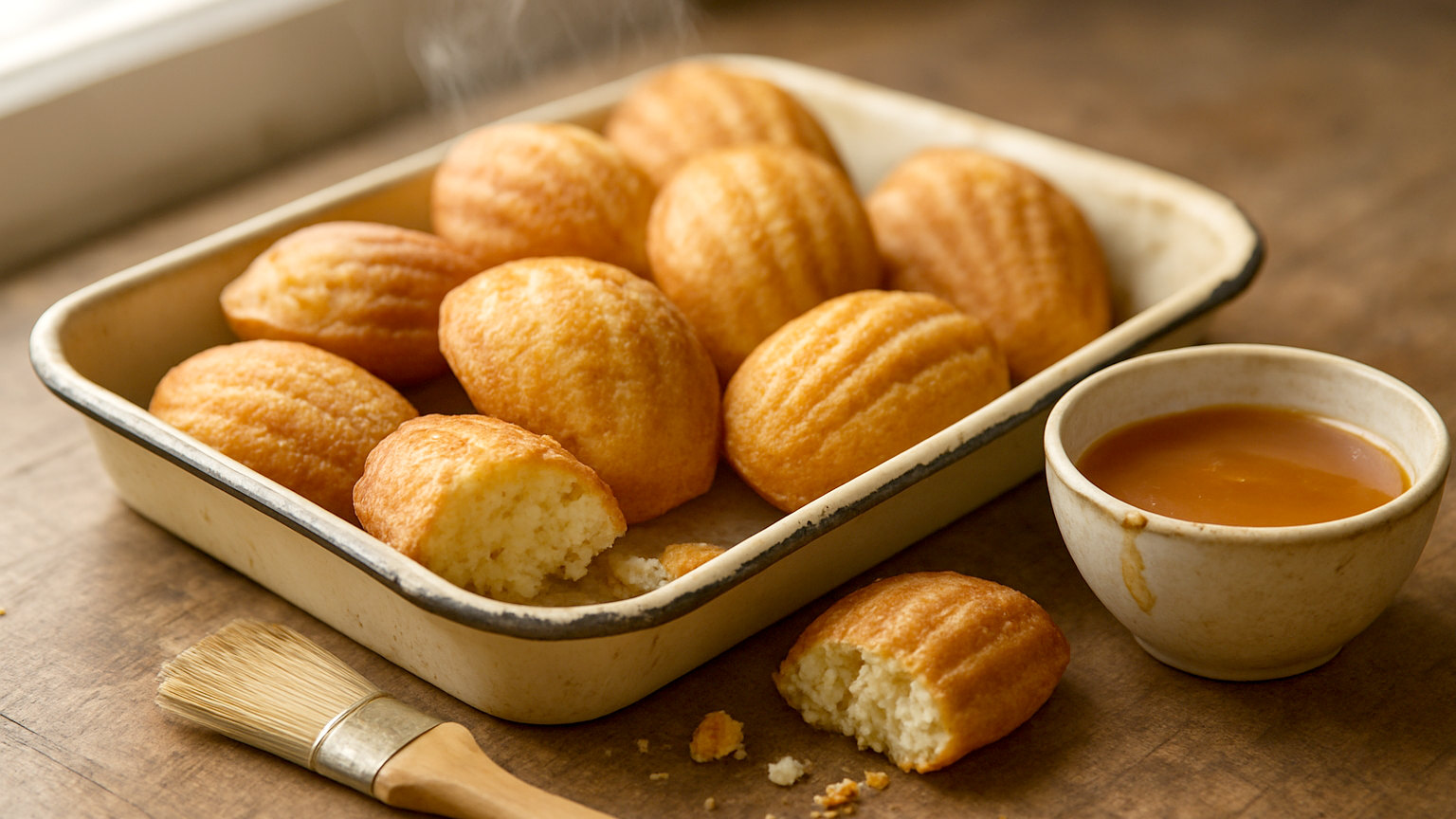
Madeleines are small shell-shaped sponge cakes with crisp golden edges, a soft centre and a distinctive raised hump on the underside. They come from the Lorraine region of France and are traditionally flavoured with lemon or orange zest. They take minutes to make, though the batter needs chilling, and they are famously best eaten within a few minutes of coming out of the oven.
What creates the hump?
Thermal shock. Cold batter goes into a hot, well-greased tin, and the outside sets almost immediately while the centre is still liquid. As the raising agent works, the only place the batter can expand is upwards through the middle, forming the characteristic bump. Chilling the batter for at least an hour, and the tin too if possible, is what makes it happen.
What ingredients do you need?
Makes 12 madeleines.
- 2 large eggs
- 100g caster sugar
- 100g plain flour
- 1 tsp baking powder
- Finely grated zest of 1 lemon
- 100g unsalted butter, melted and cooled, plus extra for greasing
- 1 tbsp honey
- A pinch of fine salt
How do you make madeleines?
- Whisk the eggs and caster sugar together for four to five minutes, until thick, pale and doubled in volume.
- Sift in the flour, baking powder and salt, and fold in gently with the lemon zest.
- Fold in the melted butter and honey until just combined.
- Cover and chill the batter for at least one hour, or overnight.
- Grease a madeleine tin very thoroughly with melted butter and dust with flour, tapping out the excess. Chill the tin too.
- Heat the oven to 200°C (180°C fan), gas 6.
- Spoon the cold batter into the moulds, filling each about three-quarters full. Do not spread it.
- Bake for 8 to 10 minutes, until risen with a humped centre and golden at the edges.
- Turn out immediately onto a wire rack.
Grease every ridge of the tin: madeleine moulds are shell-shaped with fine grooves, and any patch left ungreased will hold on to the cake. Brush melted butter into each ridge, then dust with flour.
Why must the batter be chilled?
Cold batter meeting a hot tin is the whole mechanism behind the hump. It also thickens the batter so it stays in a mound rather than spreading, and it lets the flour hydrate, which improves the texture. An hour is the minimum; overnight gives a slightly better rise and a finer crumb.
Do you need a madeleine tin?
For the traditional shell shape, yes. The moulds are shallow and ridged, and nothing else gives quite the same crisp edges and neat form. Without one, you can bake the batter in a mini muffin tin for a similar taste, though it will be a small sponge cake rather than a madeleine.
Why must they be eaten fresh?
Madeleines are at their best in the first ten or fifteen minutes, when the edges are still crisp and the centre soft. They stale unusually quickly because they are small, thin and contain no fat other than butter. Within a few hours they are noticeably drier, which is why French bakeries bake them in small batches all day.
Can you flavour them differently?
Yes. Orange zest, vanilla, almond extract and a spoonful of cocoa all work. A common finish is to dip one half of each cooled madeleine in melted dark chocolate. Brown butter in place of plain melted butter gives a deeper, nutty flavour that suits them very well.
How long do they keep?
They keep for two days in an airtight tin but lose their character quickly. Refresh them for two minutes in a hot oven. The batter keeps in the fridge for two days, so it is better to chill the batter and bake in small batches as you want them.
Does the tin need chilling too?
It helps. A cold tin exaggerates the temperature difference when it hits the hot oven, which strengthens the hump. Grease and flour the tin, then put it in the fridge alongside the batter. Some bakers go further and chill both in the freezer for 20 minutes before baking.


