
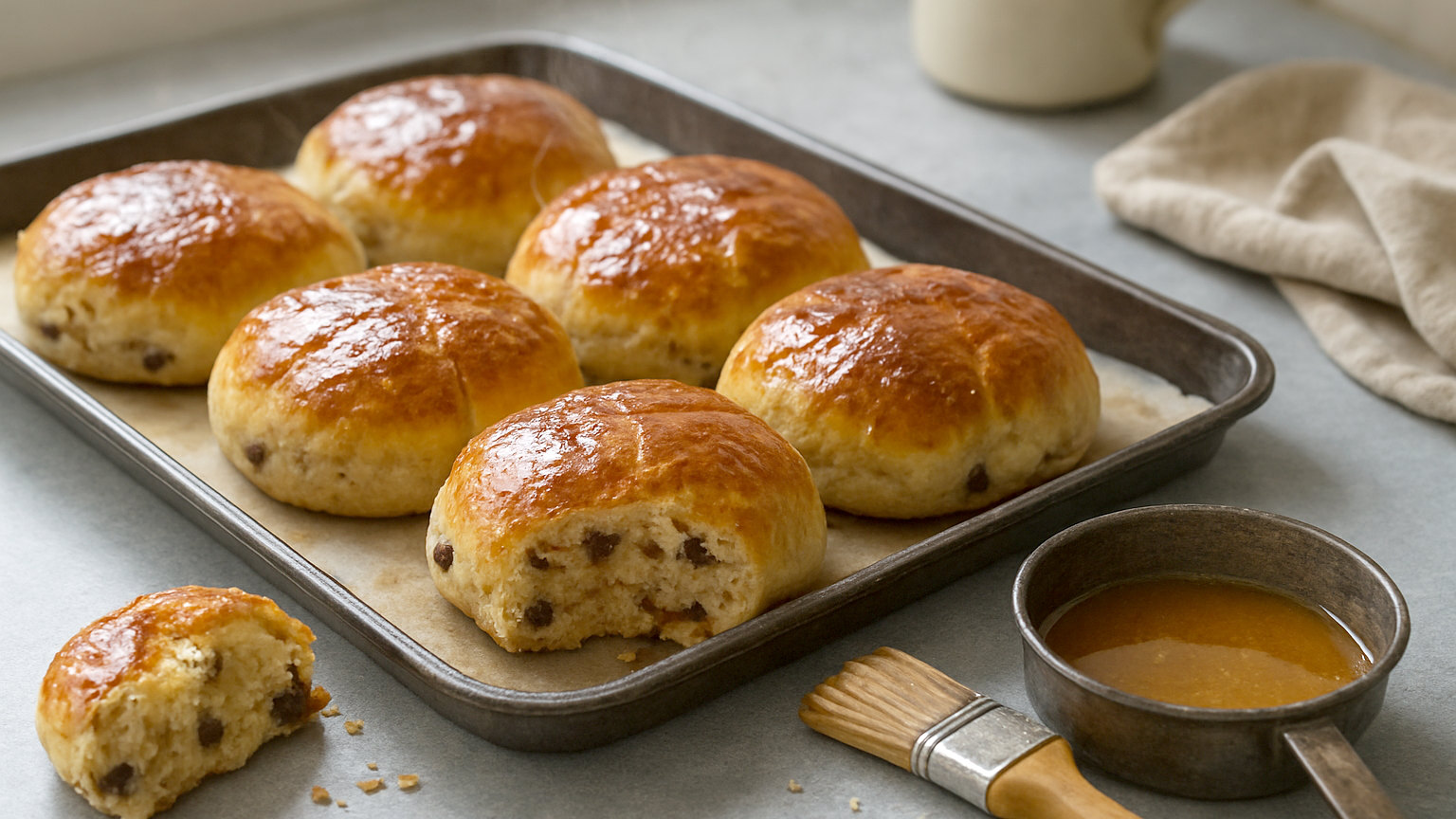
Teacakes are soft, lightly spiced yeasted buns studded with dried fruit, shaped flatter than a bread roll so they split and toast neatly. They are made specifically to be toasted, buttered and eaten warm, which is why they are flatter and less sweet than most sweet buns. A batch takes an afternoon, mostly waiting, and they freeze extremely well.
Why are teacakes flat?
The flat, disc-like shape is deliberate. A teacake is meant to be split horizontally and toasted, and a tall, round bun gives an awkward, uneven surface with too much crumb in the middle. Pressing each bun down to about 2cm thick before the second prove gives two even halves that toast flat and evenly.
What ingredients do you need?
Makes 8 teacakes.
- 500g strong white bread flour
- 7g sachet fast-action dried yeast
- 50g caster sugar
- 1½ tsp fine salt
- 1 tsp mixed spice
- 300ml warm whole milk
- 50g unsalted butter, melted
- 1 large egg
- 150g mixed dried fruit
- 50g mixed peel
- 1 beaten egg, to glaze
How do you make teacakes?
- Mix the flour, yeast, sugar, salt and mixed spice, keeping the salt and yeast apart at first.
- Add the warm milk, melted butter and egg, and mix to a soft dough.
- Knead for 10 minutes until smooth and elastic.
- Work in the dried fruit and mixed peel, then prove for one to two hours until doubled.
- Knock back and divide into eight equal pieces, shaping each into a tight ball.
- Flatten each one with your palm to about 2cm thick and place on lined trays.
- Cover and prove for 45 minutes, until puffy.
- Brush with beaten egg and bake at 200°C (180°C fan), gas 6, for 15 to 18 minutes, until golden.
- Cool on a wire rack.
Flatten them properly: a teacake that has been shaped like a roll rises into a dome and cannot be split evenly. Press each one down firmly before the second prove.
Why are they toasted rather than eaten fresh?
Teacakes are perfectly good fresh, but toasting is the point of them. It crisps the cut surface, warms the fruit and melts the butter into the crumb. The slightly drier, less sweet dough is designed for this. A very rich, sugary bun would burn under a grill before it toasted.
How do you toast them properly?
Split them horizontally with a serrated knife and toast under a grill or in a toaster, cut side up, until golden. Butter them generously while still hot so it melts in. A teacake straight from the freezer can be split and toasted from frozen, taking a minute or two longer.
What is the difference from a hot cross bun?
They are close relatives made from similar dough. Hot cross buns are sweeter, more heavily spiced, shaped round and tall, marked with a cross and glazed. Teacakes are plainer, flatter, less spiced and unglazed, made to be split and toasted rather than eaten as they are.
Can you leave out the peel?
Yes. Mixed peel divides opinion, and leaving it out gives a plainer, fruitier teacake. Replace it with an extra 50g of sultanas or raisins. Some bakers add the zest of an orange instead, which gives the citrus note without the texture that people object to.
How long do they keep?
They keep for two days in an airtight container and are best toasted after the first day. They freeze exceptionally well for three months, which is the main reason to make a batch. Freeze them whole or split, ready to toast straight from frozen.
Why did mine rise into domes?
They were not flattened enough before the second prove, or the dough was over-proved and had too much lift left in it. Press each bun down firmly to about 2cm and accept that they will puff up a little during proving and baking. A domed teacake still tastes good but is awkward to split.
Can you make them without a mixer?
Yes. Kneading by hand takes about 10 minutes and is straightforward with this dough, which is soft but not especially sticky. Push it away with the heel of your hand, fold it back and turn it a quarter, repeating until it feels smooth and springs back when pressed.


