
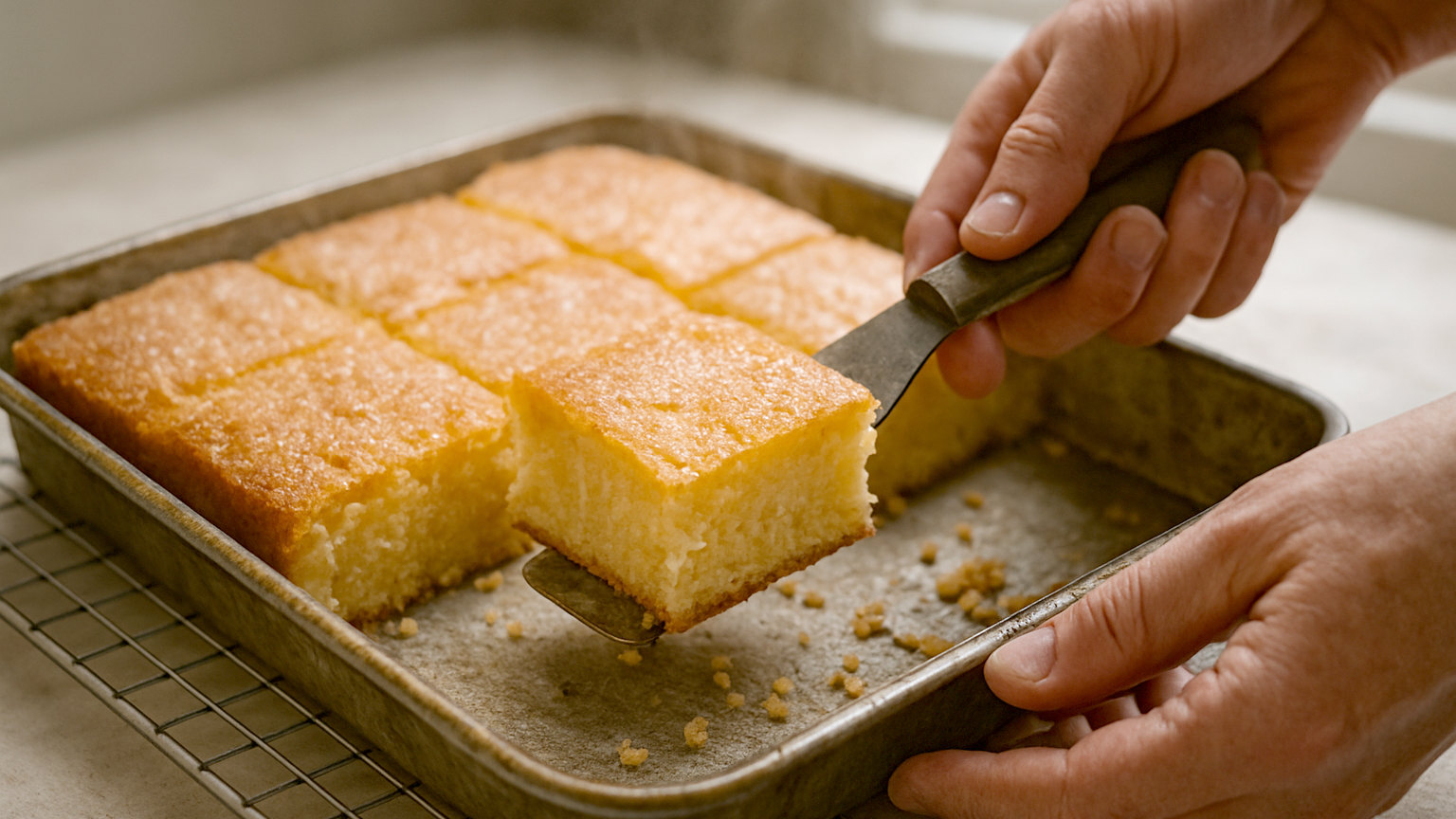
A lemon drizzle traybake is the same much-loved cake as the loaf version, baked in a large rectangular tin and cut into squares. It feeds around 20 people, takes less time to bake than a loaf, and travels well, which is why it appears at every bake sale, coffee morning and village fête in the country. The all-in-one method means it comes together in one bowl.
Why bake it as a traybake?
A traybake is quicker, easier to portion and far easier to transport than a loaf or a layer cake. The shallower depth means it bakes in about half the time, and there is no levelling, filling or icing. Squares are simpler to price and hand round at an event, and the tin itself doubles as the carrying container.
What ingredients do you need?
Makes 20 squares.
For the sponge
- 350g unsalted butter, very soft
- 350g caster sugar
- 6 large eggs
- 350g self-raising flour
- 1 tsp baking powder
- Finely grated zest of 3 unwaxed lemons
- 4 tbsp milk
For the drizzle
- Juice of 3 lemons, about 150ml
- 175g granulated sugar
How do you make a lemon drizzle traybake?
- Heat the oven to 180°C (160°C fan), gas 4. Line a 30 by 23cm traybake tin with baking paper.
- Put all the sponge ingredients into a large bowl and beat with an electric mixer for about two minutes, until smooth and evenly combined.
- Spread into the tin and level the surface.
- Bake for 30 to 35 minutes, until golden and springy, and a skewer comes out clean.
- While it bakes, stir the lemon juice and granulated sugar together without letting the sugar dissolve completely.
- As soon as the cake comes out, prick it all over with a skewer, right down to the base.
- Spoon the drizzle evenly over the hot cake and leave it to cool completely in the tin before cutting.
Drizzle it hot: the syrup must go on while the sponge is straight from the oven. A cooled cake will not absorb it, and the sugar stays wet instead of forming a crust.
Why use granulated sugar in the drizzle?
Granulated sugar has larger crystals than caster sugar, so it does not fully dissolve in the lemon juice. The juice soaks into the sponge while the undissolved crystals stay on the surface and set into a thin, crunchy crust. Caster sugar gives a smooth glaze instead, and icing sugar gives an opaque icing, both of which are pleasant but different.
Which tin should you use?
A 30 by 23cm traybake tin, about 4cm deep, is the standard and gives 20 generous squares. A slightly larger roasting tin works but gives a thinner cake, so reduce the baking time by about five minutes. Line it with baking paper that overhangs the long sides so you can lift the whole slab out once cool.
Can you make it in advance?
Yes. It keeps for four days in an airtight container and is arguably better on the second day, once the drizzle has permeated the sponge. Bake it the day before an event. It also freezes well for three months, either whole or in squares, and defrosts in about two hours.
How do you transport it?
The simplest method is to leave it in the tin, cover with foil or a lid and cut it on arrival. If it is already cut, layer the squares in a rigid box with baking paper between the layers. The drizzle makes the surface slightly sticky, so avoid stacking them directly on top of one another.
Can you use other citrus?
Yes. Orange makes a sweeter, gentler traybake, and lime gives a sharper one. A mixture of lemon and lime is particularly good. Whichever you use, keep the quantity of juice in the drizzle the same, as this is what soaks the sponge.
Why is my traybake dry?
Overbaking is the usual reason, and a shallow traybake goes from perfect to dry in a few minutes. Start checking at 30 minutes. Skipping the drizzle, or adding it once the cake has cooled, also leaves it dry, since the syrup is what keeps the sponge moist for days.


