
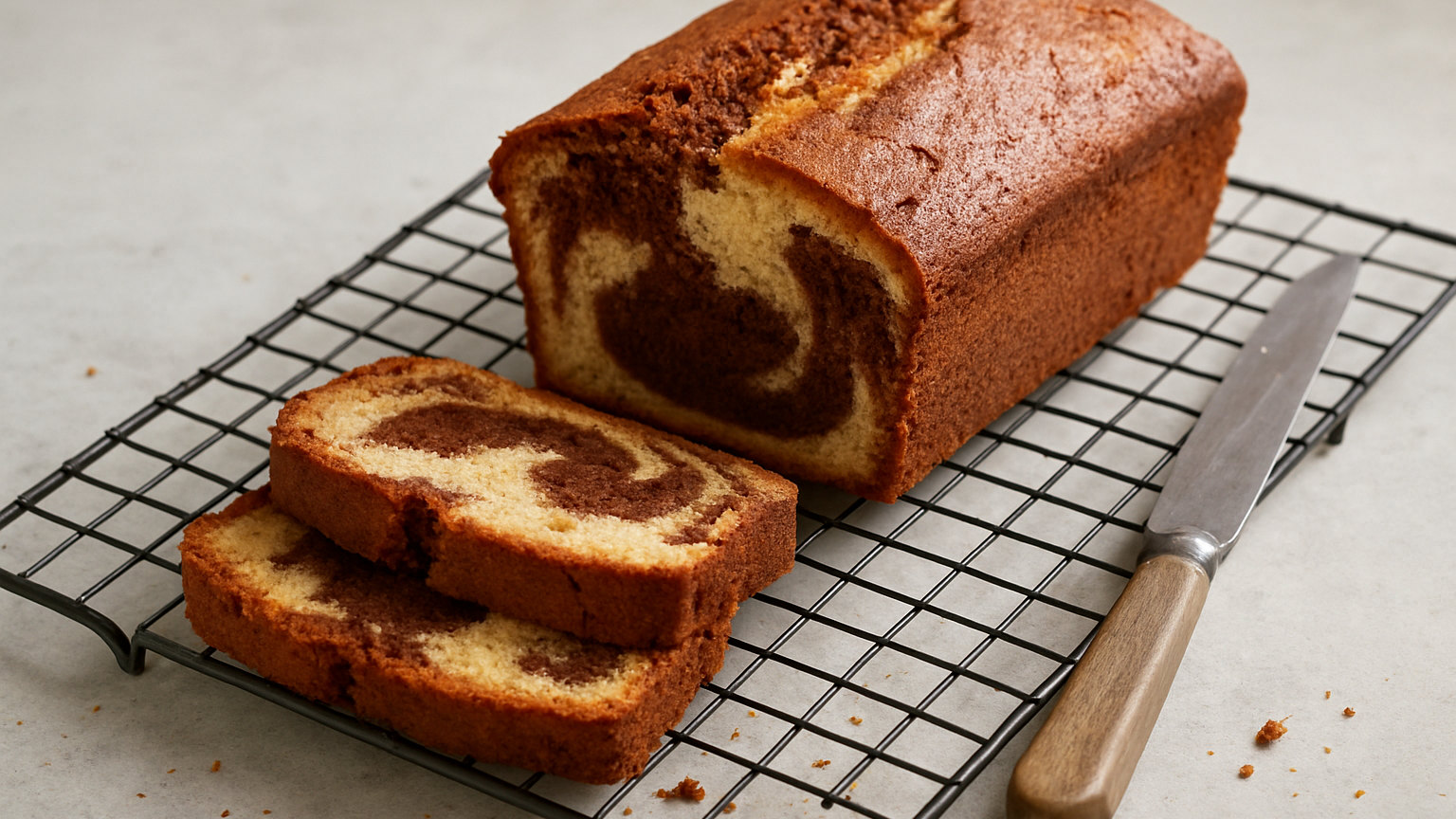
A marble loaf cake is a soft, buttery sponge made from two mixtures, one vanilla and one chocolate, spooned into the tin together and gently swirled. When you slice it, every piece reveals its own unique pattern of light and dark sponge. It is a favourite with children, looks impressive with very little effort, and is simple enough to make together as a family baking project.
Where does marble cake come from?
Marble cake is thought to have originated in Germany, where it is known as Marmorkuchen and is traditionally baked in a ring-shaped tin. Early versions swirled a plain cake with a spiced, molasses-darkened batter, and chocolate became the favourite contrast later. Today it is baked around the world, in loaf tins, ring tins and round tins.
How do you get a clear marble pattern?
The secret is to swirl only briefly. Spoon the vanilla sponge and chocolate mixture into the tin in alternating dollops, then drag a skewer or knife through the mixture just once or twice in a figure-of-eight movement. If you swirl too much, the two colours blend into a muddy brown and the marble effect is lost. Less is definitely more.
What ingredients do you need?
For the cake
- 175g unsalted butter, softened
- 175g caster sugar
- 3 large eggs
- 175g self-raising flour
- 1 tsp baking powder
- 1 tsp vanilla extract
- 3 tbsp milk
- 2 tbsp cocoa powder
For the chocolate glaze
- 75g dark chocolate
- 25g unsalted butter
How do you make a marble loaf?
- Heat the oven to 180°C (160°C fan), gas 4. Grease a 900g loaf tin and line with baking paper.
- Beat the butter and sugar until pale and fluffy, then beat in the eggs one at a time.
- Sift in the flour and baking powder, and fold in with the vanilla and 2 tbsp of the milk.
- Spoon half the mixture into a second bowl.
- Sift the cocoa powder into one bowl and add the remaining tablespoon of milk, then fold until evenly chocolate-coloured.
- Spoon alternate dollops of the vanilla and chocolate mixtures into the tin.
- Drag a skewer through the mixture once or twice to create swirls, then level the top gently.
- Bake for 45 to 55 minutes, until risen and a skewer comes out clean.
- Cool in the tin for 10 minutes, then turn out onto a wire rack.
- For the chocolate glaze, melt the chocolate and butter together, then spoon over the cooled cake.
Match the texture: the cocoa makes the chocolate mixture stiffer, which is why it gets an extra splash of milk. Both mixtures should be the same consistency so they swirl and bake evenly.
Can you make it with the all-in-one method?
Yes. Put all the cake ingredients except the cocoa and one tablespoon of the milk into a bowl and beat with an electric mixer for two minutes until smooth. Then divide the mixture and add the cocoa and milk to one half. The all-in-one method gives a slightly denser sponge, but it is quicker and good for baking with children.
Can you add other colours?
Yes. For a colourful marble cake, divide the vanilla mixture into three and colour each with a few drops of gel food colouring, then swirl them together. Strawberry marble cake uses a little freeze-dried strawberry powder in one half, and an orange and chocolate version adds orange zest to the vanilla sponge.
How long does it keep?
Store the marble loaf in an airtight tin at room temperature for up to four days. It freezes well for up to three months, with or without the glaze. For lunchboxes, freeze individual slices and take them out in the morning.
Can you bake it in a round or ring tin?
Yes. A 20cm round tin works well and takes about 35 to 40 minutes. A traditional ring or bundt tin gives the classic German shape; grease it very thoroughly, including every groove, and bake for 40 to 45 minutes. Whatever tin you use, swirl the mixture only once or twice so the pattern stays clear.


