
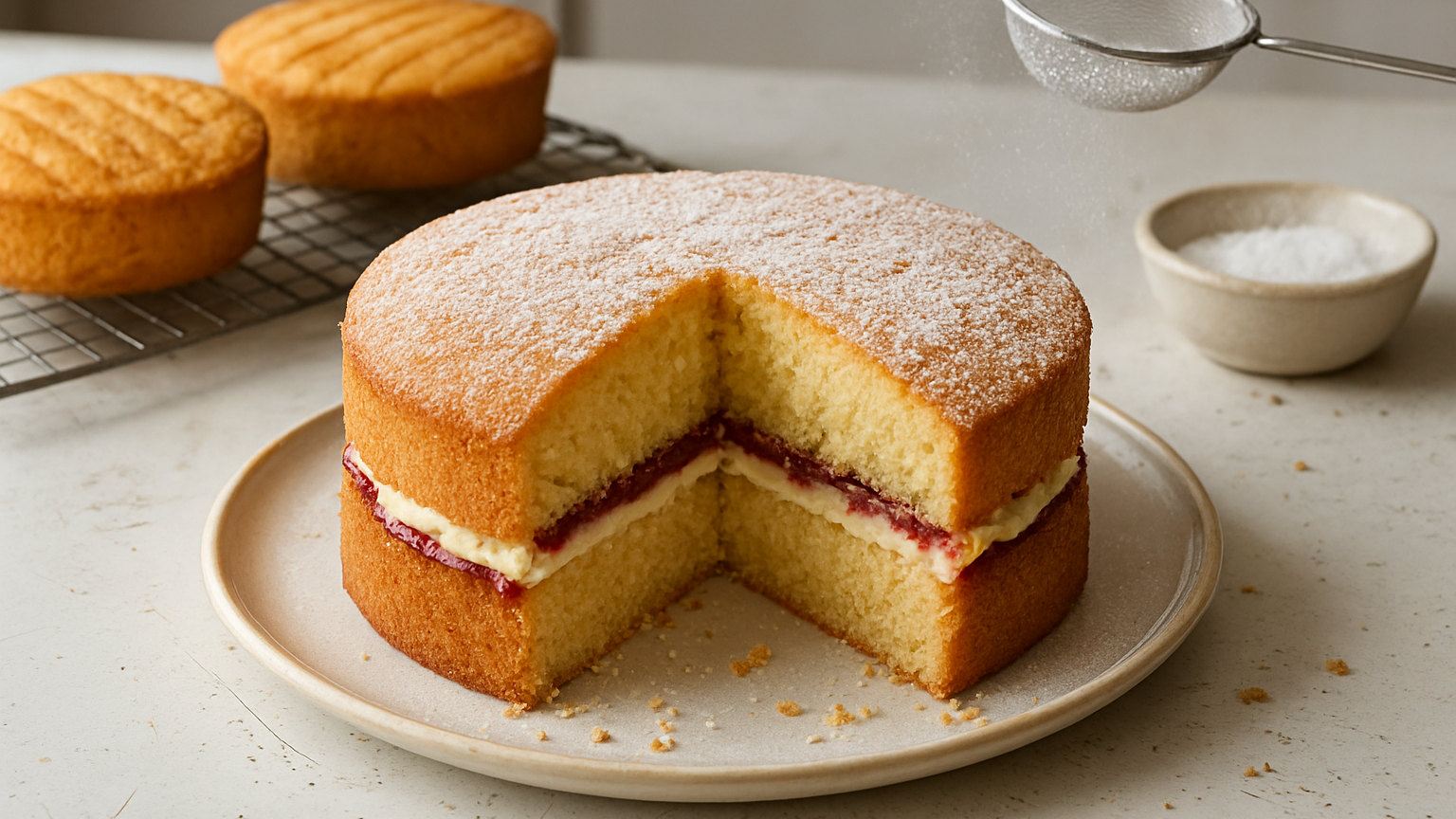
A Victoria sponge is two light, golden butter sponges sandwiched with raspberry jam and usually buttercream or whipped cream, with a dusting of caster sugar on top. It is the benchmark of British baking and the cake most people learn first. The traditional recipe uses equal weights of butter, sugar, eggs and self-raising flour, which makes it easy to remember and easy to scale to any size of tin.
Why is it called a Victoria sponge?
The cake is named after Queen Victoria, who is said to have enjoyed a slice of sponge with her afternoon tea. The ritual of afternoon tea became fashionable during her reign, and a simple jam-filled sponge became one of its staples. The name stuck, and today it remains the classic choice for village shows, cake stalls and birthday teas.
Why weigh the eggs?
Eggs vary in size, so the most reliable method is to weigh them in their shells and then use the same weight of butter, sugar and flour. Four large eggs weigh roughly 220 to 240g once cracked, which is why so many classic recipes use 225g each of butter, sugar and flour. Matching the weights keeps the balance of fat, sugar and flour correct, and it is the secret to a consistently light sponge.
What ingredients do you need?
For the sponge
- 225g unsalted butter, softened
- 225g caster sugar, plus extra for dusting
- 4 large eggs, at room temperature
- 225g self-raising flour
- 1 tsp baking powder
- 1 tbsp milk
For the filling
- 100g unsalted butter, softened
- 200g icing sugar
- 1 tsp vanilla extract
- 5 tbsp good raspberry jam
How do you make a Victoria sponge?
- Heat the oven to 180°C (160°C fan), gas 4. Grease two 20cm sandwich tins and line the bases with baking paper.
- Beat the butter and caster sugar together for four to five minutes, until very pale and fluffy.
- Beat in the eggs one at a time, adding a spoonful of the flour with the last one if the mixture looks curdled.
- Sift in the remaining self-raising flour and baking powder, then fold in gently with the milk until smooth.
- Divide evenly between the tins. Weighing each tin is the easiest way to get equal layers.
- Bake for 20 to 25 minutes, until golden, well risen and springy.
- Cool in the tins for five minutes, then turn out onto a wire rack.
- Beat the filling butter, icing sugar and vanilla until smooth and fluffy.
- Spread the jam over the base of one sponge and the buttercream over the other, sandwich together and dust the top with caster sugar.
Top tip: place the bottom sponge upside down, so its flat base becomes the surface you fill. The finished cake sits level and the jam does not slide.
Should you fill it with cream or buttercream?
Both are traditional. Buttercream keeps well at room temperature for several days, which is why it is used at most cake sales. Whipped double cream is lighter and fresher but must be kept in the fridge and eaten within a day or two. Purists at some baking competitions insist on raspberry jam alone, with no cream at all, and a dusting of caster sugar on top.
How do you know when it is baked?
The sponge should be evenly golden, risen and just shrinking from the sides of the tin. Press the centre lightly with a fingertip; it should spring back rather than leave a dent. A skewer pushed into the middle should come out clean. If the top is browning too quickly, lay a sheet of baking paper loosely over the tins for the last few minutes.
How long does a Victoria sponge keep?
Filled with buttercream and jam, the cake keeps for two to three days in an airtight tin at room temperature. With fresh cream, keep it in the fridge and eat it within 24 hours. The un-filled sponges freeze well for up to three months, wrapped individually in cling film, and they defrost in about two hours.
Can you make it in one tin?
Yes. Bake all the mixture in one deep 20cm round tin at 170°C (150°C fan) for 45 to 55 minutes, then split it horizontally once cool. The lower temperature stops the outside overbaking before the thicker middle is cooked through.


