
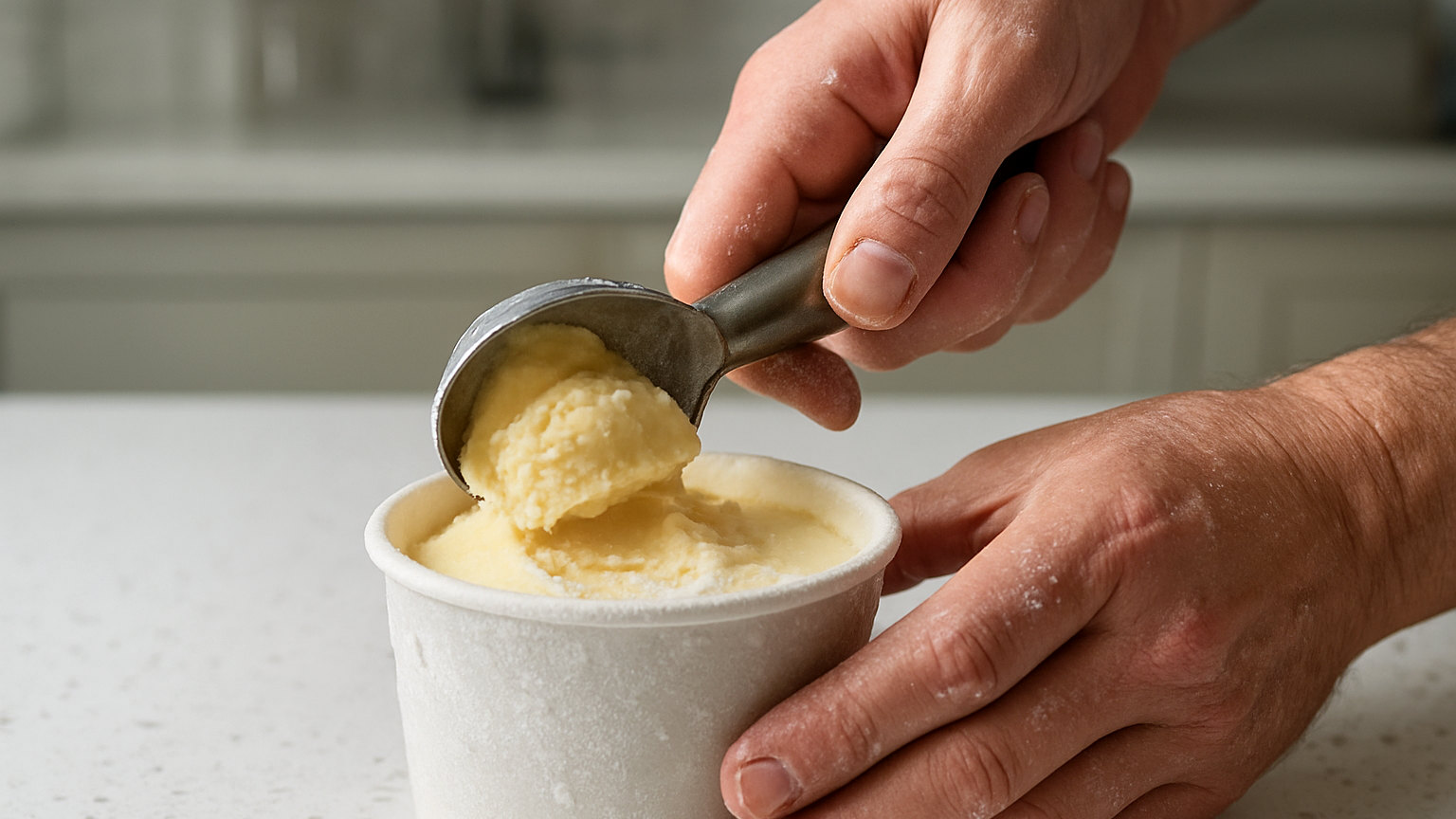
Ice cream is icy because the ice crystals in it are too large to feel smooth on the tongue. Every problem comes back to that. Crystals grow when the mixture freezes slowly, when there is too much free water, or when partly melted ice cream refreezes. Fix those three things and the texture looks after itself.
What causes large ice crystals?
| Cause | Why it matters | Fix |
|---|---|---|
| Base not fully chilled | Freezes slowly in the machine | Chill overnight before churning |
| Too little fat | Nothing interrupts the crystals | Use double cream and yolks |
| Too little sugar | Water freezes more readily | Do not reduce the sugar |
| Watery fruit added | Adds free water to freeze | Roast or reduce the purée first |
| Freezer too warm | Slow freezing, large crystals | Set the freezer to -18°C |
| Refreezing after melting | Crystals re-form much larger | Never refreeze softened ice cream |
Why does the base need to be properly cold?
A base at room temperature takes a long time to reach freezing point in the machine, and slow freezing means large crystals. A base at fridge temperature, ideally chilled overnight, freezes quickly and the crystals stay microscopically small. This is the single most common reason homemade ice cream is icy.
Why does fat matter so much?
Fat globules physically get in the way of ice crystals as they form and grow, keeping them small. That is why a custard made with double cream and egg yolks produces smooth ice cream, and why low-fat versions are almost always icy. Reducing the cream to make a lighter ice cream nearly always backfires.
Why should you not reduce the sugar?
Sugar does structural work, not just flavouring. Dissolved sugar lowers the freezing point of the water in the mixture, so less of it turns to ice at freezer temperature. Cut the sugar and more water is free to freeze into crystals. If the sweetness bothers you, add something sharp or salty rather than removing sugar.
Never refreeze ice cream that has melted: the crystals re-form far larger than before and the texture is permanently ruined. This includes a tub left out during a meal and put back afterwards.
Does the freezer temperature matter?
Yes. A domestic freezer should run at around -18°C. Warmer than that, and ice cream freezes slowly and softens repeatedly as the door is opened, which lets crystals grow. Store ice cream at the back rather than in the door, where the temperature fluctuates most every time the freezer is opened.
What about adding alcohol or syrup?
Both lower the freezing point and keep the texture softer. A tablespoon of vodka, which has no flavour, or a spoonful of golden syrup per litre of base makes a noticeable difference without being detectable. Do not exceed about two tablespoons of spirits, or the ice cream will not set firm at all.
How long should you churn it?
Twenty-five to thirty-five minutes in a domestic machine, until the mixture is thick and holds a soft peak. Under-churning leaves it too liquid and it freezes into a block. Over-churning is possible too: past about forty minutes, the fat can begin to separate and the texture turns buttery.
Can you rescue icy ice cream?
Partly. Let it soften slightly, blitz it in a food processor until smooth and refreeze it quickly in a shallow container. It will not be as good as a properly churned batch, but it is a considerable improvement on a grainy block, and it is far better than throwing it away.
Does the type of sugar matter?
Yes. Invert sugars such as golden syrup, honey and glucose lower the freezing point more effectively than ordinary caster sugar, so replacing about a quarter of the sugar with syrup gives a noticeably softer texture. This is why commercial ice creams list glucose syrup among their ingredients.
Do egg yolks help?
Considerably. Yolks contain lecithin, a natural emulsifier that holds fat and water together and keeps ice crystals small. A custard base with five or six yolks per litre is much smoother than a cream and sugar mixture frozen alone, which is the main reason custard-based ice cream is worth the extra work.


