
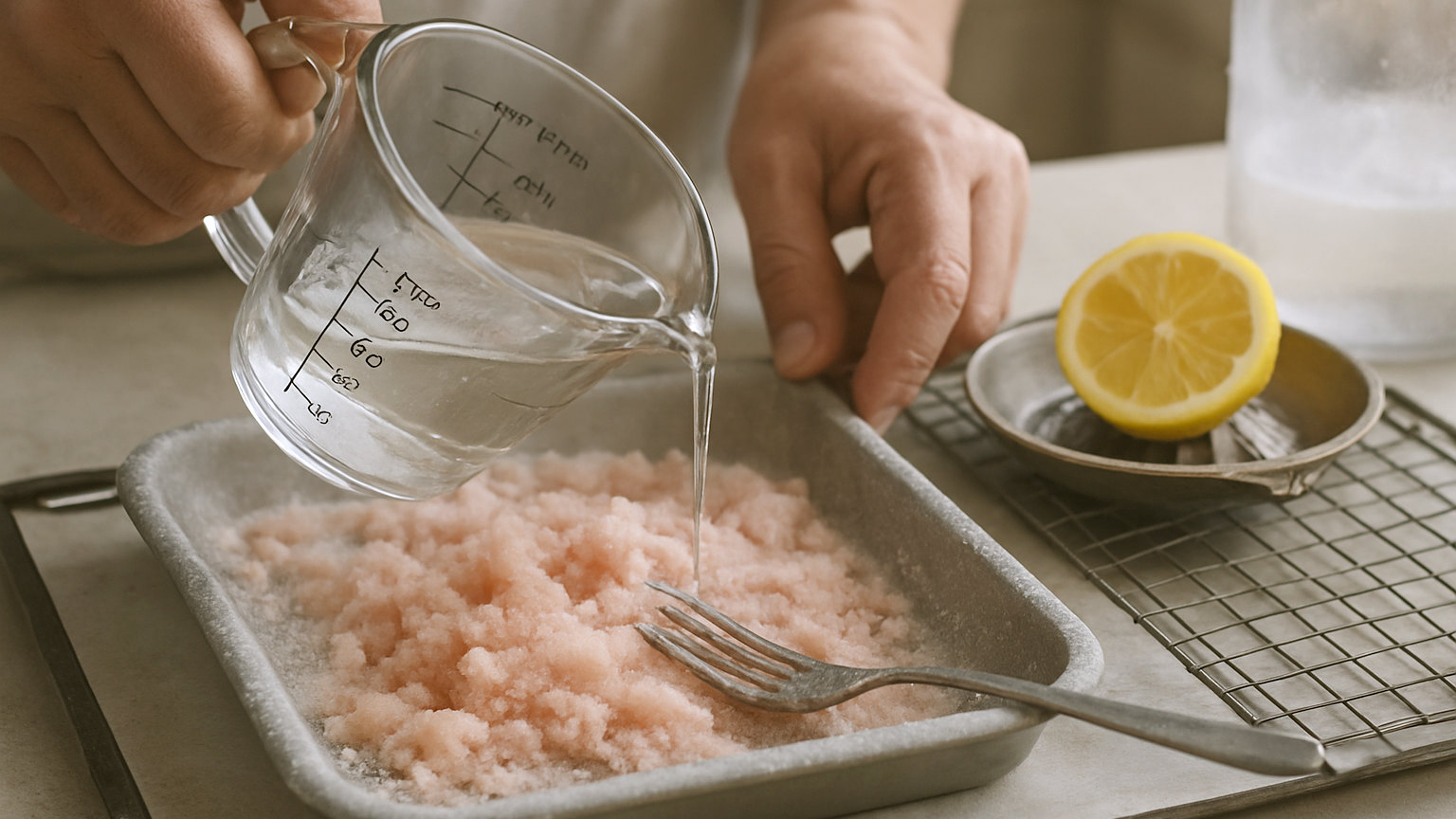
Almost every sorbet starts with a sugar syrup: sugar dissolved in water, simmered briefly and cooled. It exists because sugar dissolves readily in hot water and badly in cold fruit purée, and because the sugar is doing structural work as well as sweetening. Getting the quantity right is the single thing that decides whether a sorbet is smooth or a block of ice.
What strength should the syrup be?
A standard sorbet syrup is equal weights of sugar and water, which is called a 1:1 or simple syrup. Some recipes use a heavier 2:1 syrup for very acidic fruit. What matters more than the syrup itself is the final sugar concentration once it meets the fruit, which should be somewhere between 25 and 30%.
How do you make it?
- Put equal weights of caster sugar and water in a pan, for example 250g of each.
- Heat gently, stirring, until every grain of sugar has dissolved.
- Stop stirring, bring to a simmer and let it bubble for one minute.
- Take off the heat and cool completely before using.
- Store in a clean jar in the fridge.
Stop stirring once it simmers: agitating a boiling syrup encourages sugar crystals to form on the sides of the pan, and those crystals can seed the whole batch into graininess.
What is the egg float test?
An old and surprisingly reliable way of judging sugar concentration. Float a clean fresh egg in the cold sorbet mixture: a circle of shell about the size of a five pence piece should show above the surface. Less showing means too little sugar; more means too much. Wash the egg before and discard it after.
Why does the sugar level matter so much?
Dissolved sugar lowers the freezing point of water, so at freezer temperature some of the mixture stays liquid and the sorbet remains scoopable. Too little sugar and nearly all the water freezes, giving a solid block. Too much and so little freezes that the sorbet never sets at all, staying as a slush.
Can you reduce the sugar to make it healthier?
Not without ruining the texture. This is the most common mistake people make with sorbet. If the sweetness bothers you, add more acidity instead: extra lemon or lime juice makes a sorbet taste sharper without changing the sugar balance that the texture depends on.
Should you use glucose syrup?
Replacing about a quarter of the sugar with glucose or golden syrup gives a noticeably smoother texture, because invert sugars lower the freezing point more effectively and interfere with crystal growth. Commercial sorbets nearly always contain glucose for this reason. It is worth doing if you make sorbet often.
Can you infuse the syrup?
Yes, and it is one of the easiest ways to add flavour. Simmer the syrup with citrus zest, herbs such as mint or basil, vanilla, cinnamon, star anise or lemongrass, then leave it to infuse off the heat for twenty minutes and strain. The syrup carries the flavour into the sorbet without adding liquid.
How long does sugar syrup keep?
A month in a sealed jar in the fridge, and longer if you make a heavier 2:1 syrup, which is more resistant to spoiling. Keeping a jar ready means a sorbet can be made whenever good fruit appears, since the syrup is the only part that needs cooking.
Do all sorbets need a syrup?
Almost all, but not quite. Very sweet fruit such as ripe mango or banana sometimes needs only a little sugar stirred in, and some recipes dissolve sugar directly into a warm fruit purée. The syrup method is more reliable because you can measure and taste the sweetness before it meets the fruit.
Can you use honey or maple syrup instead?
Yes, and both behave like invert sugars, so they keep the texture soft. They bring their own flavour, which suits some fruit and overwhelms others. Honey is good with lemon, fig and apricot; maple suits apple and pear. Use about three-quarters the weight of sugar, as both are sweeter.


