
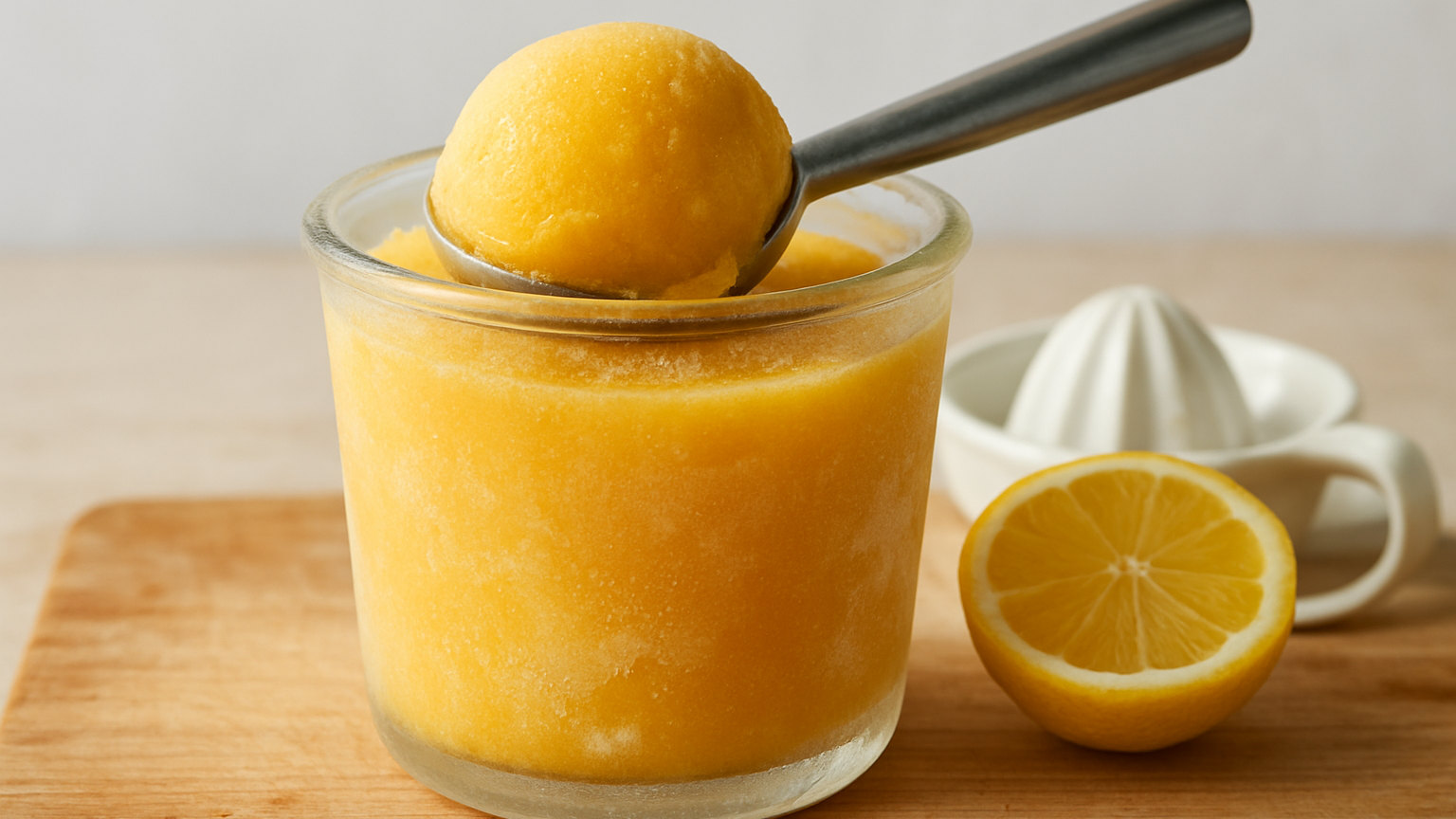
Mango sorbet is golden, fragrant and considerably easier than most, because ripe mangoes are already high in sugar and thick enough in texture that they need very little help. The main adjustment is adding less syrup than you would for a berry sorbet, and enough lime juice to stop the result tasting flat.
What ingredients do you need?
Makes about 800ml.
- 3 large ripe mangoes, about 700g flesh
- 125g caster sugar
- 100ml water
- Juice of 2 limes, about 4 tbsp
- A pinch of fine salt
How do you make mango sorbet?
- Heat the sugar and water in a pan, stirring until dissolved, then simmer for one minute and cool completely.
- Peel the mangoes and cut the flesh from the stones.
- Blend until completely smooth, then push through a sieve if the purée is at all fibrous.
- Stir in the cooled syrup, lime juice and salt.
- Taste, and add a little more lime if it seems flat or a little more syrup if it seems very sharp.
- Chill for at least six hours, until completely cold.
- Churn for 20 to 30 minutes, then freeze for four hours before serving.
Taste the mixture before churning: mangoes vary enormously in sweetness, far more than most fruit, so this is one sorbet where the recipe quantities are a starting point rather than a rule.
Why does it need less sugar than other sorbets?
Ripe mangoes contain around 14% sugar, roughly double that of raspberries, so a good deal of the sweetness is already there. Adding a full berry-sorbet quantity of syrup would push the mixture past the point where it can freeze firm, leaving something closer to a thick, slushy purée.
How do you choose a ripe mango?
A ripe mango gives slightly when pressed near the stalk and smells sweet and fragrant at that end. Colour is not a reliable guide, as varieties differ. Alphonso and Kesar mangoes, available in early summer, have the most flavour and the least fibre, and they make by far the best sorbet.
Can you use tinned or frozen mango?
Yes to both. Tinned mango purée, often made from Alphonso mangoes, is sold in Asian food shops and is excellent, though it is usually sweetened, so reduce the syrup by half and taste. Frozen mango chunks work well, thawed and drained, and are far cheaper than fresh out of season.
Why lime rather than lemon?
Lime has a more aromatic, slightly floral acidity that suits tropical fruit better than lemon, which is sharper and more straightforward. Either works, and the point is simply to add acidity, since mango is very low in it. Without any, the sorbet tastes cloying and one-dimensional.
Why is my sorbet fibrous?
Some mango varieties, particularly the large green-skinned ones sold cheaply in supermarkets, contain noticeable fibres around the stone. Blending does not break them down. Pushing the purée through a sieve removes them entirely and takes two minutes, and it is worth doing if you are unsure of the variety.
What can you add to it?
A few cardamom pods infused into the syrup is excellent with mango, as is a pinch of chilli or a little grated fresh ginger. Passion fruit pulp stirred through adds sharpness and texture. Keep additions small, as the mango flavour is the reason for making it.
How long does it keep?
It keeps for two months in an airtight container with baking paper pressed onto the surface. Mango sorbet stays softer than most, because of the high sugar content of the fruit, so it usually needs only five minutes out of the freezer.
Why cool the sugar syrup first?
Warm syrup poured into fruit purée begins to cook it, dulling the fresh flavour and the colour. It also means the mixture has to be chilled from a much higher temperature, which takes hours longer. Make the syrup first, or keep a jar of it in the fridge ready to use.


