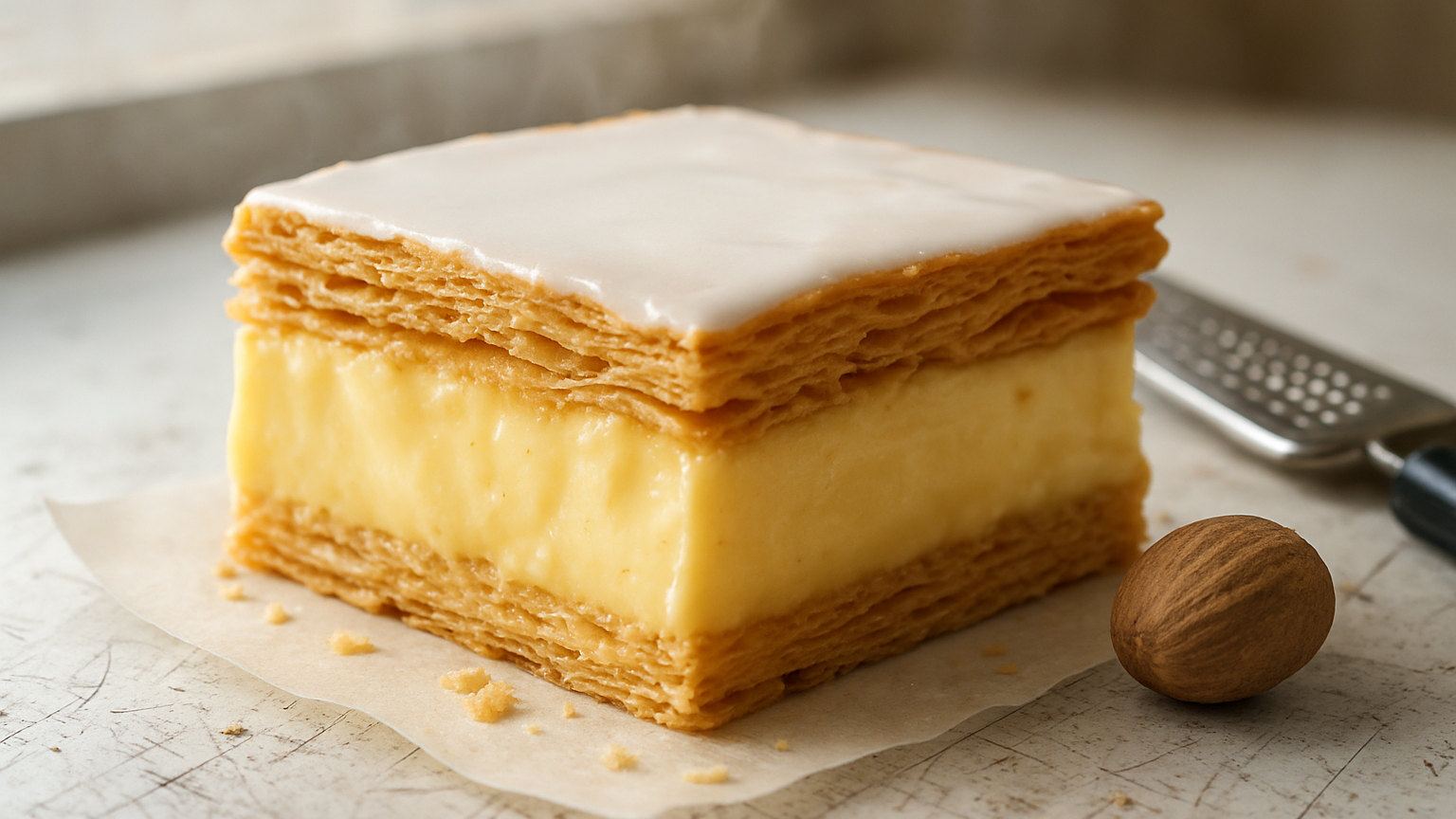
A vanilla custard slice is thick, set vanilla custard sandwiched between two sheets of crisp, flaky puff pastry, topped with smooth white icing. It is a bakery counter favourite in Britain, closely related to the French mille-feuille. The trick at home is baking the pastry flat so it stays crisp, and making the custard thick enough to hold its shape when cut, which means plenty of cornflour and a proper boil.
Why bake the pastry flat?
Puff pastry normally rises into many separate layers, which is lovely in a sausage roll but makes a custard slice impossible to assemble or eat. Baking it between two trays keeps it flat and compact, so it becomes crisp and shatters cleanly rather than puffing into a fragile tower. The layers are still there, just pressed tightly together.
What ingredients do you need?
For the pastry
- 320g sheet all-butter puff pastry
- 2 tbsp caster sugar
For the custard
- 600ml whole milk
- 1 vanilla pod, split, or 2 tsp vanilla bean paste
- 6 large egg yolks
- 125g caster sugar
- 60g cornflour
- 50g unsalted butter
For the icing
- 200g icing sugar
- 2 to 3 tbsp warm water
- 1 tbsp cocoa powder, for feathering
How do you make a custard slice?
- Heat the oven to 200°C (180°C fan), gas 6. Line two baking trays with baking paper.
- Unroll the pastry, cut it in half to make two rectangles and place them on one tray.
- Sprinkle with the caster sugar, lay baking paper on top and set the second tray on top to weigh it down.
- Bake for 20 to 25 minutes, until deep golden and crisp. Cool completely.
- Heat the milk with the vanilla until steaming. Whisk the yolks, sugar and cornflour together.
- Pour the hot milk over the yolks, whisking, then return to the pan.
- Cook over a medium heat, whisking constantly, until very thick and bubbling. Cook for two more minutes, as this custard must be stiffer than usual.
- Beat in the butter, then press through a sieve into a bowl.
- Line a 20cm square tin with cling film, lay one pastry sheet in the base, trimmed to fit, and spread the hot custard over it.
- Top with the second pastry sheet, pressing gently. Chill for at least four hours.
- Mix the icing sugar with the water to a thick paste and spread over the top. Pipe lines of cocoa icing and drag a skewer through them for feather icing.
Make the custard stiffer than you think: a custard slice needs a filling that holds a sharp edge. Two extra minutes of cooking is what separates a neat slice from a collapsing one.
How do you cut it neatly?
Chill the assembled slice thoroughly, ideally overnight. Use a long, sharp serrated knife and cut with a gentle sawing motion rather than pressing down, which would squeeze the custard out. Wipe the blade between cuts. Some bakers ice the top pastry sheet separately before assembling, then cut it into portions first and lay them on.
What is the difference between a custard slice and a mille-feuille?
A mille-feuille has three layers of pastry and two of crème pâtissière, and is usually finished with feathered white and chocolate icing. A British custard slice has two pastry layers, a thicker custard and often plain white icing. Vanilla slice is another name for the same thing, and in Australia it is sometimes called a snot block.
Why is my custard runny?
Cornflour only thickens fully once it boils, so the custard must bubble properly in the pan. If it is still soft after chilling, it was undercooked or short of cornflour. This filling needs noticeably more cornflour than a tart filling, because it has to stand alone between two pastry sheets.
How long does it keep?
Eat it within 24 hours, as the pastry softens against the custard. Keep it in the fridge, and take it out 15 minutes before serving so the custard is not too firm.