
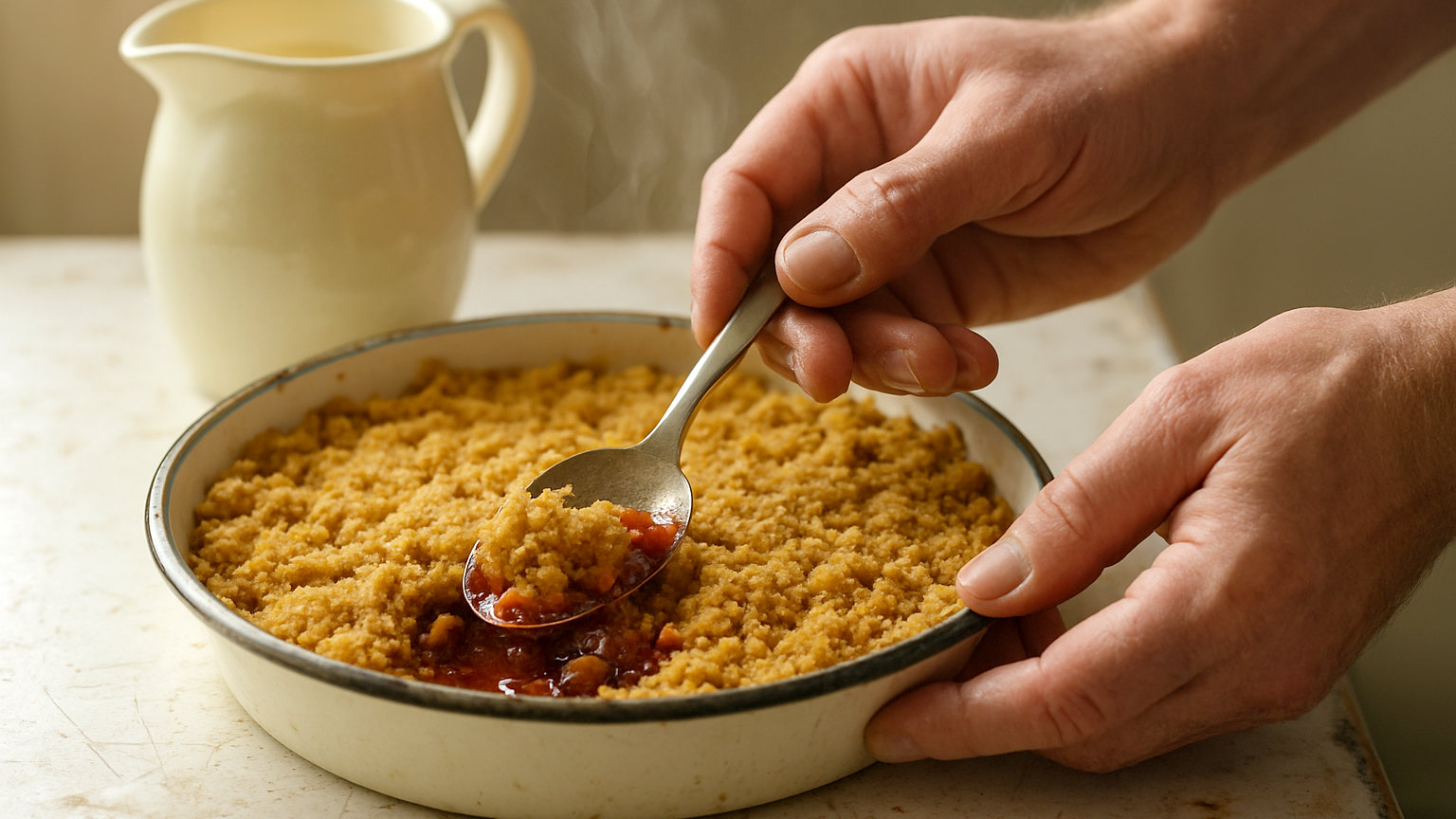
A crumble topping is two parts flour to one part butter to one part sugar by weight, rubbed together until it looks like coarse breadcrumbs. That ratio is worth memorising, because it scales to any quantity and any fruit. Everything else, the oats, the nuts, the type of sugar, is a variation on that base, and each one changes the texture in a predictable way.
What is the classic ratio?
| Dish size | Flour | Butter | Sugar |
|---|---|---|---|
| Small, 4 servings | 150g | 75g | 75g |
| Standard, 6 servings | 200g | 100g | 100g |
| Large, 8 to 10 servings | 300g | 150g | 150g |
Weigh the butter cold from the fridge and cube it before you start. If you want a richer, more shortbread-like topping, increase the butter towards 60% of the flour weight, but no further, or it will melt into a greasy layer.
Should you use your fingers or a food processor?
Fingers give more control and let you feel when the mixture is right, and lifting it high and letting it fall keeps it cool. A food processor is quicker and keeps the butter colder because your hands never touch it, but it is easy to overdo, turning the mixture into a paste. Pulse it, and stop while it still looks rough.
Stop while it is still uneven: a crumble should have lumps of different sizes, from fine crumbs to pieces the size of a pea. A uniform topping bakes into a flat, sandy layer with no crunch.
What can you add for crunch?
Porridge oats are the most common addition, giving a chewy, rustic texture; use about 50g per 200g of flour. Demerara sugar has large crystals that stay crunchy. Ground almonds in place of some flour give richness, and chopped nuts, particularly hazelnuts and pecans, add real bite. Desiccated coconut works well with tropical fruit.
Which sugar should you use?
A mixture is best. Caster sugar dissolves and helps the topping hold together, while demerara stays granular and crunchy. Light brown sugar adds a caramel note that suits apple and plum. Avoid using only caster sugar, which gives a topping that is sweet but flat, or only demerara, which can be gritty.
How thick should the topping be?
About 2cm deep over the fruit, which usually means a topping roughly half the depth of the fruit layer. Too thin and it disappears into the juices; too thick and the underside stays raw and pasty while the top browns. Scatter it loosely rather than pressing it down.
Why does the topping sink into the fruit?
Either the fruit was very juicy and the topping absorbed the liquid, or the topping was pressed down so it had no air in it. Toss juicy fruit with a tablespoon of cornflour, keep the topping loose, and consider baking the fruit alone for 15 minutes first so it stops bubbling up so vigorously.
Can you make it ahead?
Yes, and it is worth doing. The rubbed-in topping keeps in an airtight container in the fridge for a week and freezes for three months. Scatter it straight from frozen over fruit and bake, adding five minutes. Keeping a bag in the freezer means a crumble is never more than an hour away.
Can you make it gluten-free or vegan?
Both, easily. Use a gluten-free plain flour blend in place of the flour, which works well since no gluten development is wanted. For a vegan version, use a firm vegan block butter rather than a soft spread. Ground almonds and oats suit both versions, though check that oats are labelled gluten-free if needed.
Why does the butter need to be cold?
Cold butter stays in small distinct pieces as you rub it in, and those pieces melt in the oven to leave air pockets, which is what makes a topping crisp rather than dense. Warm butter blends into the flour and produces a paste that bakes into a solid, greasy layer.
How do you rub it in properly?
Use your fingertips, not your palms, as fingertips are cooler. Pick up a little flour and butter, press and slide your thumb across your fingers, then let the mixture fall back into the bowl. Lifting it high as it falls keeps it aerated and cool. Work quickly and stop as soon as it looks like coarse breadcrumbs.


