
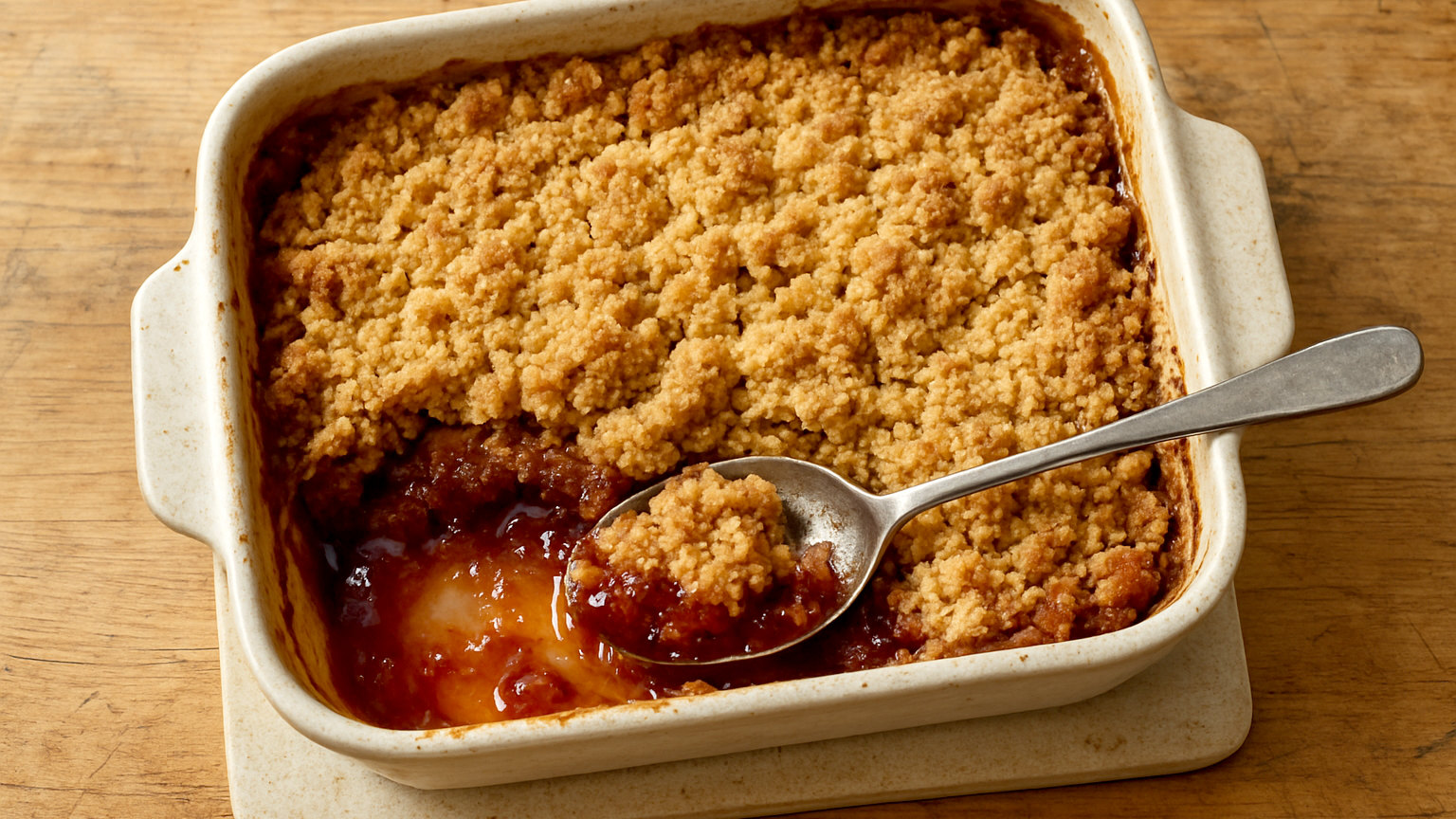
A crumble goes soggy when liquid from the fruit reaches the topping faster than the oven can drive it off. That happens for three main reasons: the fruit was too juicy and nothing was added to thicken it, the topping was pressed down so steam could not escape, or the oven was too cool. All three are easy to fix.
What are the common problems?
| Problem | Cause | Fix |
|---|---|---|
| Wet topping over the fruit | Juices bubbling up | Add cornflour to the fruit |
| Pale, pasty topping | Oven too cool | Bake at 190°C |
| Topping sunk into the fruit | Pressed down, or too thin | Scatter loosely, at least 2cm deep |
| Fruit still hard | Dense fruit, not pre-cooked | Pre-cook firm fruit for 10 minutes |
| Burnt top, raw fruit | Oven too hot or dish too deep | Lower the shelf, cover with foil |
| Greasy topping | Butter too warm | Use butter straight from the fridge |
How do you stop juicy fruit flooding?
Toss the prepared fruit with a tablespoon of cornflour before it goes into the dish. The starch thickens the released juice into a syrup rather than letting it run free. For very wet fruit such as rhubarb, drain it with sugar in a colander for half an hour first and increase the cornflour to two tablespoons.
Why does pressing the topping down make it soggy?
A compacted topping has no gaps for steam to escape through, so moisture from the fruit is trapped underneath and the crumb layer stews rather than crisps. Scattering it loosely leaves channels for steam to rise and escape. It also gives the uneven, clumpy texture that makes a crumble worth eating.
Never press it down: this single habit causes more soggy crumbles than anything else. Scatter it from a height and leave it looking rough and uneven.
How hot should the oven be?
190°C, or 170°C fan, gas 5. A moderate oven gives the topping enough heat to dry out and colour while the fruit softens beneath. At 160°C the topping stays pale and damp even after an hour. If your crumble is consistently pale, check your oven with a thermometer, as many run cooler than the dial suggests.
Should you bake the fruit first?
For juicy or firm fruit, yes. Fifteen minutes in the oven before the topping goes on lets the fruit release its liquid and start thickening, so the topping meets a set filling rather than a rising tide. It is not necessary for Bramley apples, which soften in the same time the topping takes.
How deep should the topping be?
About 2cm, roughly half the depth of the fruit. A thin layer is overwhelmed by the juices and disappears. A very thick layer stays raw and pasty underneath while the surface browns. Matching the topping to the dish rather than the recipe is worth doing if your dish is unusually wide or narrow.
Can you rescue a soggy crumble?
Partly. Return it to a hot oven on a high shelf for 10 to 15 minutes, which drives off some moisture and crisps the surface. If the topping has genuinely dissolved into the fruit, scatter a handful of toasted oats and demerara sugar over the top and grill briefly, which gives back some crunch.
Does the dish make a difference?
Yes. A wide, shallow dish gives a greater surface area of topping relative to fruit, so more of it crisps. A deep, narrow dish traps steam and gives a wetter result. Ceramic and glass heat slowly, so a metal dish or a preheated baking tray underneath helps the base cook through.
Does the type of topping matter?
It does. A topping containing porridge oats, demerara sugar or ground almonds stays crisper against wet fruit than one made from flour, butter and caster sugar alone, because the coarser ingredients absorb a little moisture without turning pasty. Adding 50g of oats to a standard crumble topping is worthwhile insurance.
Should you serve it straight from the oven?
Rest it for ten minutes. Straight from the oven the juices are still thin and bubbling, and they soak upwards into the topping as you serve. Ten minutes lets the filling thicken and settle, so the topping stays crisp on the plate rather than going wet the moment it is spooned out.


