
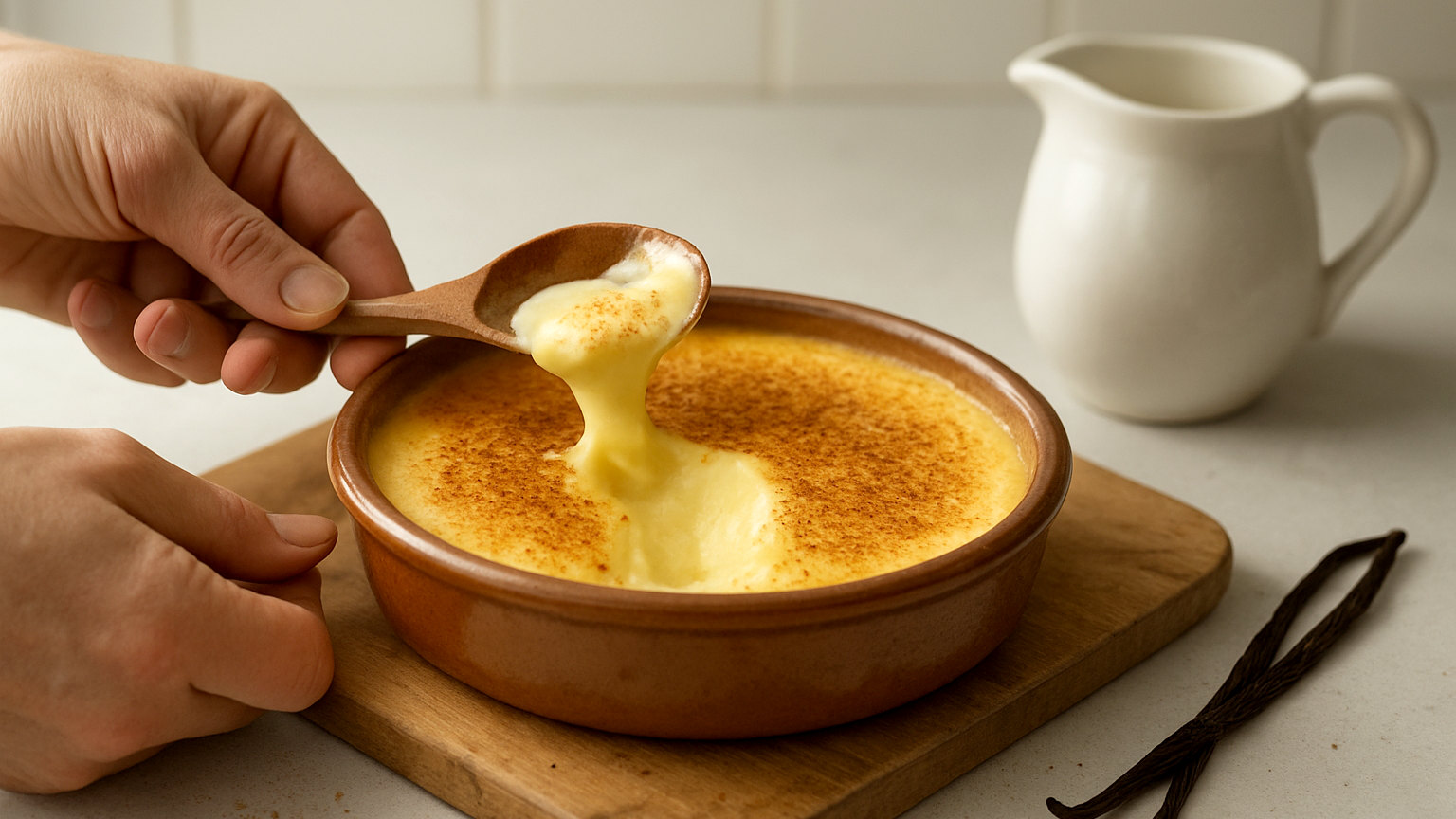
A baked egg custard is about as plain as puddings get: milk, cream, eggs, sugar and vanilla, poured into a dish, grated over with nutmeg and baked very slowly until just set. There is no pastry, no caramel and nothing to hide behind, which is exactly why it is worth making well. Served cold with stewed fruit, it is quietly excellent.
What ingredients do you need?
Serves 6.
- 500ml whole milk
- 200ml double cream
- 1 tsp vanilla extract, or a split vanilla pod
- 4 large eggs plus 2 yolks
- 75g caster sugar
- Whole nutmeg, for grating
How do you make baked egg custard?
- Heat the oven to 150°C (130°C fan), gas 2. Butter a 1.2 litre baking dish.
- Heat the milk, cream and vanilla until steaming but not boiling, then leave to infuse for 10 minutes.
- Whisk the eggs, yolks and sugar together gently, without creating foam.
- Pour the warm milk over the eggs while whisking.
- Strain through a fine sieve into a jug and skim off any bubbles.
- Pour into the dish and grate nutmeg generously over the surface.
- Stand the dish in a roasting tin and pour in boiling water to come halfway up the sides.
- Bake for 45 to 55 minutes, until set at the edges with a distinct wobble in the centre.
- Cool completely, then chill before serving.
Skim off the foam: bubbles left on the surface bake into pale freckles across the top. A quick pass with a spoon, or blotting with kitchen paper, gives a flawless finish.
Why bake it so slowly?
Egg proteins begin to set around 70°C and tighten above 85°C, at which point the custard curdles and weeps water. A low oven of 150°C, combined with a water bath, keeps the temperature gentle so the eggs set smoothly. A hot oven produces a pitted, watery custard every time.
How do you know when it is set?
The edges should look firm and matt while the centre still moves as one piece when you nudge the dish, like a soft jelly. It should not ripple or slosh. An instant-read thermometer in the middle should show about 78 to 80°C. It continues setting as it cools, so a slight wobble is correct.
Why is nutmeg traditional?
Nutmeg and egg custard have been paired in English cookery for centuries, and the warm, slightly sweet spice is the accepted finish. Grate it fresh from a whole nutmeg, as ready-ground loses its fragrance within months. Add it before baking so it toasts lightly into the surface.
Can you use milk alone?
Yes, and it gives a lighter, more old-fashioned custard, closer to what would have been served in a nursery. Replace the cream with an extra 200ml of milk. The set will be slightly firmer and the flavour less rich. Keep the same number of eggs so it still sets properly.
Why did it turn watery?
It was overbaked or the oven was too hot, so the eggs curdled and squeezed out the liquid they were holding. There is no way to rescue a curdled baked custard. Next time, check from 45 minutes, take it out while the centre wobbles and make sure the water bath is topped up.
How long does it keep?
It keeps in the fridge for three days, covered. Serve it cold with stewed rhubarb, poached plums, a spoonful of jam or simply on its own. It does not freeze, as the custard separates and becomes watery when thawed.
Why use extra egg yolks?
Whole eggs alone would set the custard firmly, since egg whites are the stronger setting agent. Adding two extra egg yolks softens the set and adds richness, giving a texture that is delicate rather than rubbery. It is the same balance used in crème caramel, for the same reason. Yolks alone would give a custard too soft to serve in neat spoonfuls, and whites alone would make it springy and rubbery.


