
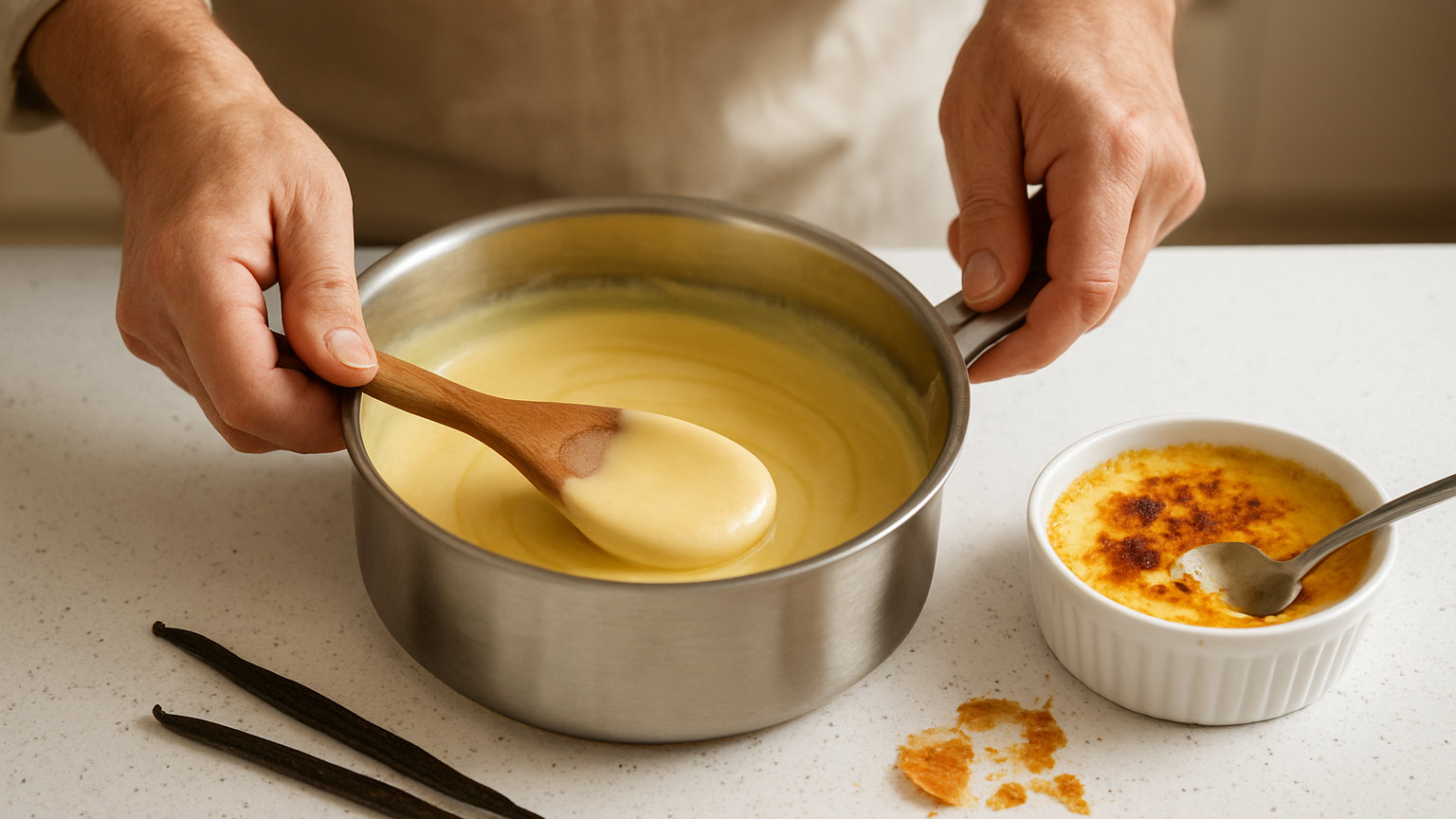
Custard is thickened either by egg yolks, by starch, or by both together. Which you choose depends entirely on what the custard is for. A pouring custard needs yolks alone and is deliberately thin; a tart filling or a trifle layer needs starch as well, and must be boiled. Most problems come from using the wrong method for the job.
How thick should custard be?
| Use | Thickened with | Consistency |
|---|---|---|
| Pouring over a pudding | Egg yolks only | Coats a spoon, pours freely |
| Filling a tart or éclair | Yolks and cornflour | Holds a spoon mark, pipes |
| Setting a trifle layer | Yolks and cornflour | Almost cuttable when cold |
| Ice cream base | Egg yolks only | Coats a spoon, pours freely |
| Baked custard or brûlée | Egg yolks only | Liquid, sets in the oven |
Why is my custard still thin?
If it is an egg custard with no starch, it probably did not reach 78 to 82°C, which is where yolks thicken. Keep it over a low heat, stirring constantly, and test with a thermometer or the spoon test. If it contains cornflour, the likely cause is that it never came to the boil, which starch requires.
Why must starch custards boil but egg custards must not?
They work in opposite ways. Egg proteins set gently between 70 and 82°C and scramble above 85, so an egg custard must stay well below boiling. Cornflour granules only swell and thicken once they reach 100°C, so a starch custard must boil. Getting these the wrong way round is the most common custard mistake.
Know which kind you are making: a custard with cornflour in it needs a full boil, and one without needs to stay off the boil entirely. The same pan technique will ruin one or the other.
How much cornflour should you use?
For a pouring custard that needs insurance against curdling, one teaspoon per 500ml is enough. For a tart filling or crème pâtissière, use around 40g per 500ml. For a trifle layer that must set into a distinct band, use 50g per 800ml of liquid. More than that gives a rubbery, gelatinous texture.
Does adding more egg yolk thicken it?
Yes, up to a point. Six yolks per 500ml gives a rich pouring custard, and eight gives a very thick one. Beyond about ten, the custard starts to taste eggy and sets too firmly. Yolks also add colour and richness, so increasing them changes more than the texture.
Can you thicken custard after it is made?
Yes, if it contains starch. Whisk a teaspoon of cornflour with two tablespoons of cold milk, stir it into the custard and bring it back to the boil, whisking. For a pure egg custard, returning it to a low heat and stirring is the only safe option, and it risks curdling, so watch it closely.
Why does custard thin out as it cools?
It should not. A custard that loosens on cooling was undercooked: either the eggs did not reach their setting temperature or the starch never boiled. Both thicken further as they chill when properly cooked. If yours consistently thins, check the temperature with a thermometer rather than guessing.
Does the type of milk matter?
Yes. Whole milk gives a richer custard that sets better than semi-skimmed, and replacing some milk with double cream thickens it further. Plant milks are generally thinner and lower in fat, so they need slightly more starch. Whatever you use, keep the total liquid the same as the recipe states.
Can you thicken it with anything else?
Arrowroot works like cornflour and gives a clearer, glossier finish, though it loses thickness if overcooked. Plain flour can be used but gives a slightly pasty taste unless cooked out properly, which is why it appears in brandy sauce but rarely in custard. Custard powder is simply cornflour with flavouring and colour added.
Does resting help?
Yes, for starch custards. A custard that seems only just thick enough in the pan will firm up considerably over a few hours in the fridge, as the starch continues to set. Judge a trifle or tart custard by how it behaves when cold rather than how it looks while hot.


