
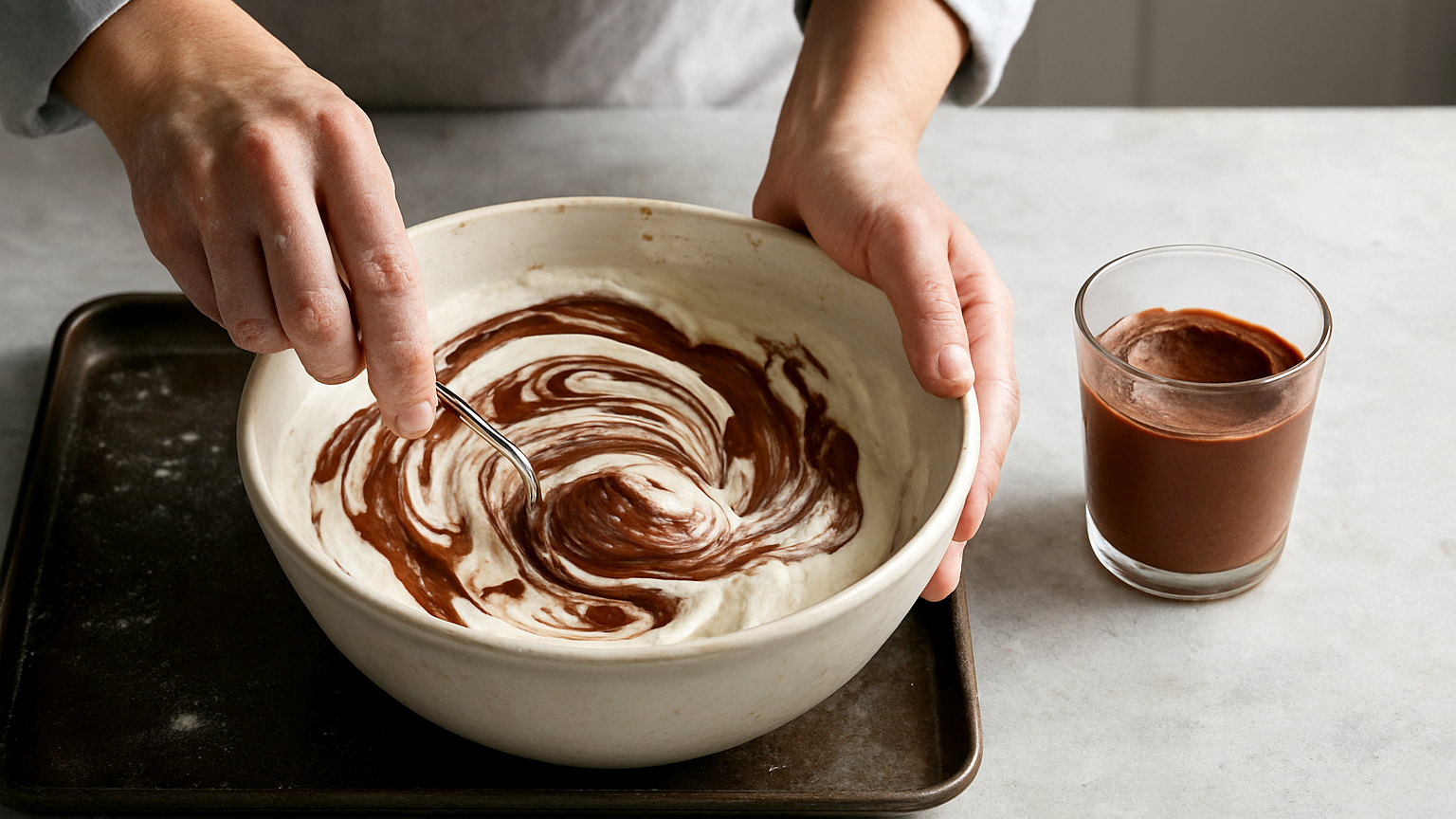
Folding is the technique for combining something light and full of air, usually whisked egg whites, with something heavier, without knocking the air out. Done well, a mousse stays light and a souffle rises. Done badly, both collapse. The whole method comes down to three things: loosen the heavy mixture first, use a large metal spoon, and stop early.
Why does folding matter?
Air is what makes a mousse a mousse. Whisked egg whites are around 90% air by volume, and every stroke of a spoon bursts some of the bubbles holding that air. Stirring destroys most of them within seconds. Folding moves the two mixtures together with the fewest possible strokes, so most of the air survives into the finished dish.
How do you fold properly?
- Add a quarter of the whisked whites to the heavier mixture and stir them in briskly. This sacrifices some air deliberately to loosen the base.
- Add half the remaining whites and take a large metal spoon.
- Cut straight down through the centre of the mixture to the bottom of the bowl.
- Sweep the spoon along the base and up the far side, lifting the heavier mixture over the whites.
- Turn the spoon over as it comes up, and rotate the bowl a quarter turn.
- Repeat, counting the strokes. Aim to finish in fifteen to twenty.
- Add the last of the whites and fold again until no white streaks remain.
Stop as soon as the streaks disappear: every stroke after that point is only losing air. A few faint streaks are far better than an overfolded, dense mixture.
Why must the bowl be grease-free?
Fat prevents egg whites forming a stable foam, and even a speck of yolk or a trace of oil from a previous use is enough to halve the volume you can whisk. Wash the bowl and whisk in hot soapy water and dry them completely, or wipe the bowl with a cut lemon and dry it.
Should you use plastic or metal bowls?
Metal or glass. Plastic is slightly porous and holds grease in its surface even after washing, which is why professional kitchens avoid it for egg whites. Copper bowls react with the whites to make a particularly stable foam, which is why they are traditional, though they are far from necessary.
What are soft and stiff peaks?
Soft peaks hold their shape briefly then flop over when the whisk is lifted. Stiff peaks stand upright and hold completely. Most mousses want firm peaks that are still glossy. Whites whisked beyond that point look dry, grainy and cotton-like, and they will not fold in smoothly, leaving lumps.
Why add cream of tartar?
Cream of tartar is an acid that stabilises the foam, making it more tolerant of overwhisting and less likely to collapse. A quarter teaspoon per four whites is enough. A few drops of lemon juice or a pinch of salt do a similar job. None is essential if the whites are whisked carefully.
Can you overwhisk egg whites?
Yes, and it is a common problem. Overwhisked whites look dry and separated rather than glossy, and the water begins to leak out of them. They cannot be rescued by more whisking. Adding one unwhisked white and whisking briefly sometimes brings them back, but starting again is usually quicker.
How do you know if you have overfolded?
The mixture will look smooth, glossy and noticeably thinner than it should, and the volume will have visibly dropped. A properly folded mousse still looks slightly uneven and holds its shape on the spoon. If it pours rather than drops, too much air has gone and it will not set light.
Does the same technique work for cream?
Yes. Whipped cream is folded into heavier mixtures in exactly the same way, and it suffers from the same problem: stirring knocks the air out and the mixture collapses. Loosen the base with a quarter of the cream first, then fold the rest in gently with a large metal spoon.
What else is folded?
Flour into a whisked sponge, whipped cream into a fruit purée, meringue into a souffle base, and egg whites into a mousse or a pancake batter. Wherever a recipe says fold rather than stir or mix, it is protecting air that something else has worked to incorporate, and the same method applies.


