
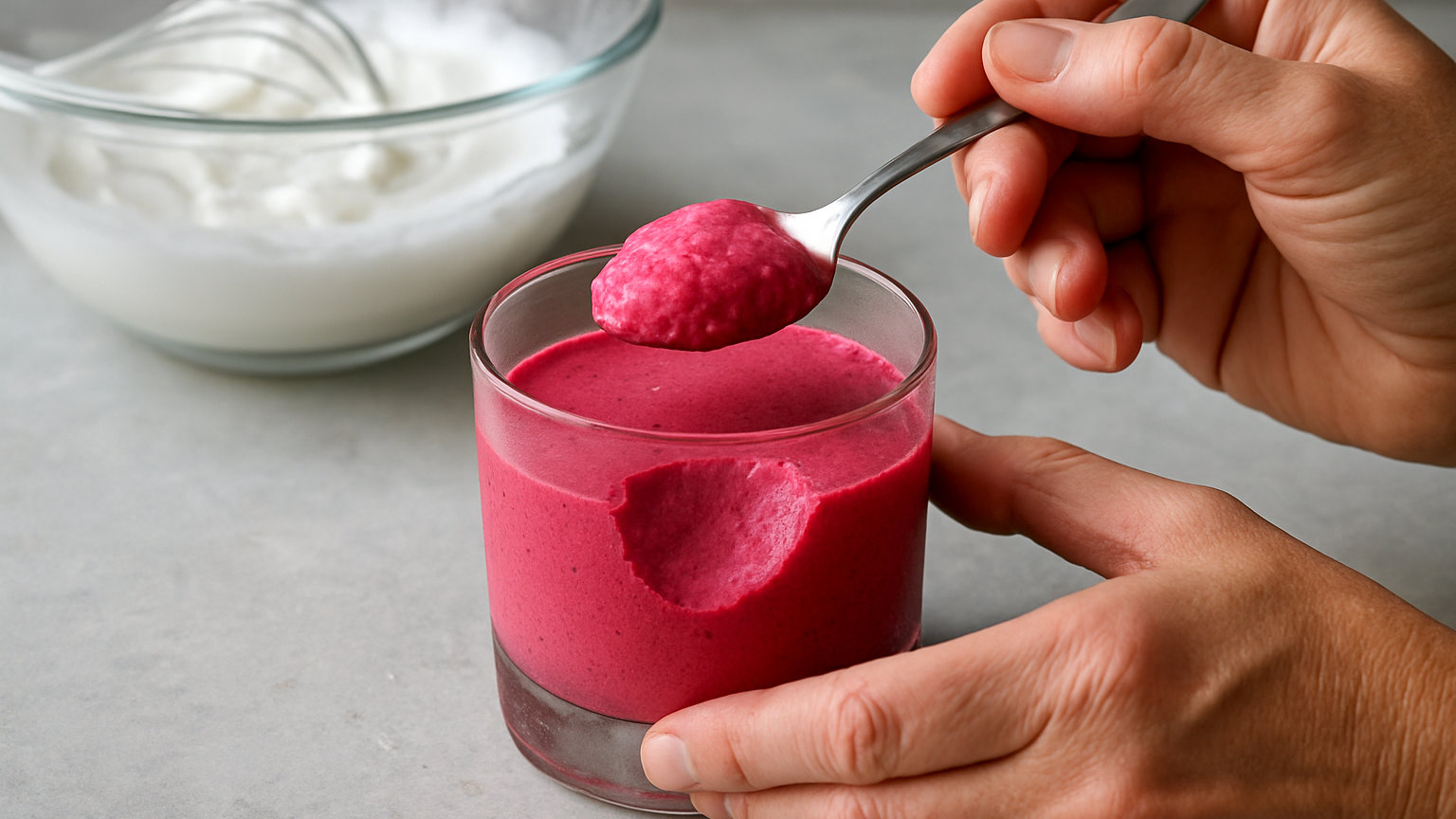
A raspberry mousse is the sharpest and most reliable of the fruit mousses. Raspberries have enough acidity to cut through cream without any help, they purée easily, and their colour is striking. The only real work is sieving out the seeds, which matters more than people expect in something as smooth as a mousse.
Why do raspberries suit mousse so well?
Most fruit is too sweet or too watery to stand up to cream and sugar. Raspberries are sharp enough to keep their character, strongly enough flavoured to survive dilution, and they contain natural pectin, which helps the mousse hold together. The colour also stays bright rather than dulling, which many fruit purées do.
What ingredients do you need?
Serves 6.
- 600g raspberries, fresh or frozen
- 125g caster sugar
- 1 tbsp lemon juice
- 3 sheets of leaf gelatine
- 300ml double cream
- 1 tsp vanilla extract
- Fresh raspberries and mint, to decorate
How do you make raspberry mousse?
- Blend the raspberries with the sugar and lemon juice until smooth.
- Push the purée through a fine sieve, pressing hard with the back of a ladle, to remove all the seeds. You should have about 450ml.
- Soak the gelatine leaves in cold water for five minutes.
- Warm 150ml of the purée until steaming, then squeeze out the gelatine and stir it in until dissolved.
- Stir this back into the remaining cold purée and cool to room temperature.
- Whip the double cream with the vanilla to soft peaks.
- Fold the cream into the purée in two additions, gently, until evenly pink.
- Divide between six glasses and chill for at least four hours.
Sieve thoroughly and press hard: raspberry seeds are small but there are a great many of them, and a mousse is smooth enough that every one is noticeable.
Should you use fresh or frozen raspberries?
Frozen are perfectly good here and often better value, since the texture of the fruit no longer matters once it is puréed. They are picked and frozen ripe, so the flavour is excellent. Thaw them completely and include the juice that collects, which is full of flavour. Use fresh ones for decorating.
How much purée do you get from 600g?
Around 450ml after sieving, which is the right quantity for this amount of cream and gelatine. You lose roughly a quarter of the weight in seeds. If your purée comes out short, top it up with a little more sieved fruit rather than water, which would dilute both the flavour and the set.
Why does the mousse go pale?
Folding cream into a red purée always lightens it considerably, and the finished mousse should be pale pink rather than crimson. If yours looks washed out, the purée was probably too thin. A few drops of beetroot powder deepen the colour naturally if you want it stronger for a party.
Can you use other berries?
Yes. Blackberries work in exactly the same way and also need sieving. Strawberries need concentrating first, as they are much more watery. Blackcurrants are very sharp, so increase the sugar to 175g. A mixture of summer berries makes a good mousse, though the colour is less clean.
Can you make it without gelatine?
For a softer version, leave the gelatine out and fold the purée into 400ml of whipped cream with 200g of mascarpone. It will not set firmly but it holds its shape in a glass. This is a useful alternative for anyone avoiding gelatine who does not want to use a vegetarian setting agent.
How long does it keep?
It keeps for two days in the fridge, covered. The colour is at its best on the first day. It does not freeze, as the cream separates and the set breaks down when thawed.
What can you serve with it?
Fresh raspberries, a crisp almond biscuit or a spoonful of white chocolate shavings. It also layers well with dark chocolate mousse, the sharp fruit against the rich chocolate, which is a classic pairing and looks striking in a glass.


