
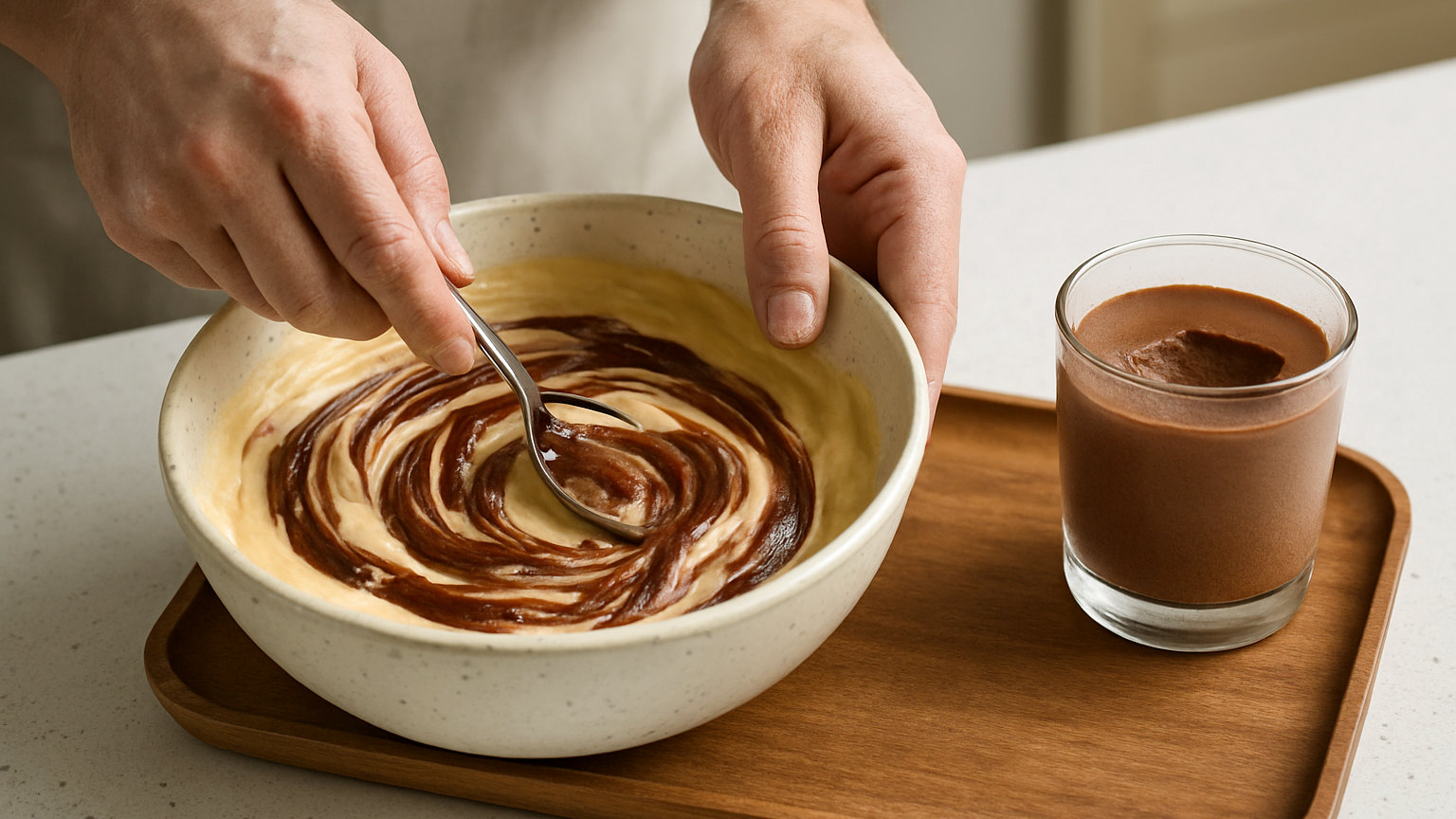
A mousse fails to set for one of three reasons: not enough setting agent, a base that was too warm when the cream or whites went in, or a mixture that was overfolded so the air was lost. Each produces a slightly different result, and knowing which you are looking at tells you whether it can be rescued or has to be started again.
What are the common faults?
| Problem | Cause | Rescue |
|---|---|---|
| Completely runny | Too little gelatine or chocolate | Re-melt with more setting agent |
| Set but dense and heavy | Overfolded, air lost | Cannot be rescued |
| Grainy or gritty | Chocolate seized or eggs cooked | Blend or sieve while warm |
| Liquid pooling underneath | Cream split, or over-whipped | Cannot be rescued |
| Rubbery and bouncy | Too much gelatine | Cannot be rescued |
| Set in lumps | Gelatine hit a cold mixture | Warm gently and re-fold |
Why is my mousse completely runny?
Either there was not enough setting agent for the volume of liquid, or the gelatine was boiled and lost its power. Chocolate mousses need around 200g of dark chocolate per 450ml of cream, and gelatine needs three leaves per 500ml for a soft set. Boiling gelatine above about 85°C weakens it considerably.
Why is it dense rather than light?
Overfolding. Every stroke after the streaks disappear pushes air out, and a mousse folded thirty or forty times has lost most of what was whisked in. It will still set and still taste good, but it will be closer to a ganache than a mousse. There is no way to put the air back.
Count your folding strokes: fifteen to twenty is usually enough. If you are still folding at thirty, the mousse is already denser than it should be.
Why is it grainy?
Either the chocolate seized, usually from a drop of water or from being too hot, or egg yolks were added to chocolate that was still hot enough to cook them. Caught while the mixture is still warm, blending with a stick blender or pushing it through a sieve often recovers it. Once chilled, it cannot be fixed.
Why is there liquid at the bottom of the glass?
The cream was whipped too far and has begun to separate, releasing water. Cream taken past soft peaks looks grainy and will weep over the following hours. Stop whisking as soon as it holds a soft shape that flops gently from the whisk. Over-whipped cream cannot be brought back.
Can you rescue a runny mousse?
Often, yes. Scrape it into a pan, warm a quarter of it gently with extra melted chocolate or an additional softened gelatine leaf until smooth, then stir it back into the rest and chill again. It will be denser than intended, since some air is lost, but it will set and taste fine.
How long should it take to set?
Four hours for a mousse in a glass, six for a firmer cake filling, and overnight for anything free-standing. Gelatine continues firming for up to 24 hours. If a mousse is still liquid after six hours in a cold fridge, it is not going to set and needs rescuing rather than more time.
How do you avoid the problem next time?
Weigh the setting agent rather than guessing, cool every base to room temperature before folding, whip cream only to soft peaks, and stop folding as soon as the streaks vanish. Those four habits prevent nearly every fault on the list.
Why did the egg yolks scramble?
They were added to chocolate that was still too hot. Melted chocolate straight from the pan can be 50°C or more, which begins cooking yolks on contact. Cool it for five minutes until it feels barely warm to the touch, then beat the yolks in one at a time.
Can a stick blender fix a split mixture?
Often, yes, provided the mixture is still warm. Blending for a few seconds re-emulsifies fat and liquid that have separated, and it will smooth out small lumps of seized chocolate. It will not put air back into an overfolded mousse, and it cannot rescue over-whipped cream.


