
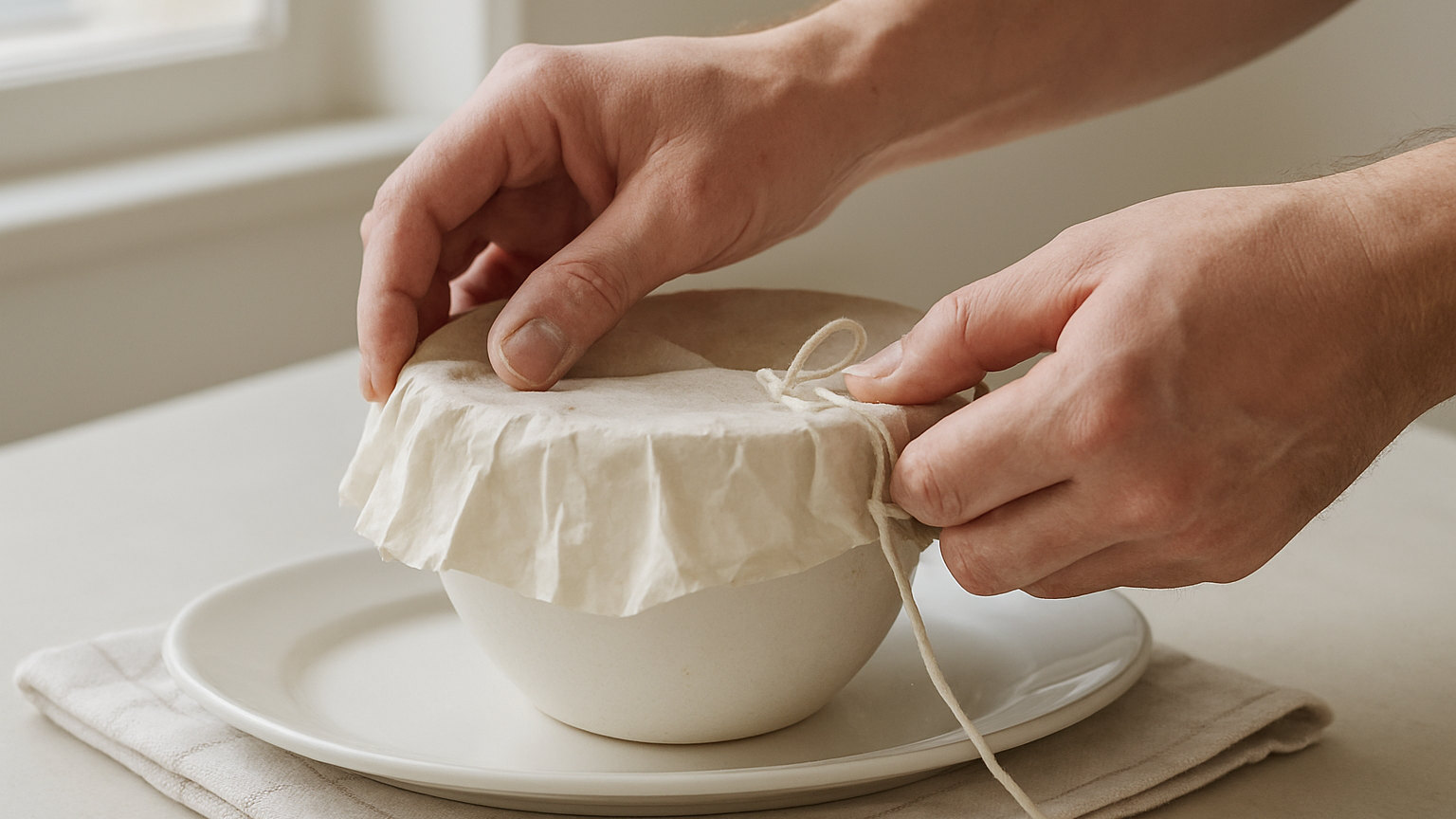
Covering a pudding basin properly is the difference between a light steamed pudding and a soggy one. The cover needs a pleat so the pudding can rise, it needs to be watertight so steam cannot get in, and it needs a string handle so you can lift a hot basin out of a pan of boiling water safely. None of it is difficult, but all of it matters.
Why does the cover need a pleat?
A steamed pudding rises considerably inside the basin. A flat, tight cover has no give, so the pudding pushes against it, the paper tears or the string slips, and water gets in. A single fold across the middle of both the paper and the foil gives 3 or 4cm of slack, which is ample room for the pudding to expand.
How do you prepare the basin?
- Grease the inside of the basin generously with softened or melted butter, using a pastry brush to get into the rim and any pattern.
- For extra insurance, cut a small disc of baking paper and press it into the base.
- If the recipe includes syrup or jam, add it now, on top of the paper disc.
- Fill the basin, leaving at least 3cm clear at the top.
Grease the rim too: it is the part people miss, and it is where a pudding sticks and tears as you turn it out.
How do you make the cover?
- Cut a square of baking paper and a square of kitchen foil, each about 10cm wider than the top of the basin.
- Lay the foil down, put the paper on top, and fold a pleat about 3cm deep across the centre of both together.
- Lay the double sheet over the basin, paper side down, with the pleat running across the middle.
- Press the edges down around the rim and smooth them against the sides.
- Tie a length of string tightly around the rim, just under the lip of the basin, and knot it firmly.
- Take a second length of string, tie it to one side of the rim string, pass it over the top and tie it to the other side to make a handle.
- Trim the excess paper and foil so it does not dangle into the water.
Why paper as well as foil?
The paper sits against the pudding and stops the foil touching it directly, which matters with acidic fillings such as lemon or marmalade, as these can react with aluminium. The foil provides the watertight layer and holds its shape once moulded around the rim. Paper alone would go soggy and sag onto the pudding.
Why do you need a string handle?
Lifting a hot, heavy basin out of a pan of boiling water is genuinely dangerous with tongs or a tea towel. A string handle across the top lets you lift it straight up with confidence. Make it loose enough to get your fingers or the handle of a wooden spoon through.
Can you use a lidded plastic basin instead?
Yes, and modern plastic pudding basins with clip-on lids are excellent. They are watertight, need no string and are easy to handle. Leave the same 3cm of headroom, and check the lid clips firmly. Some have a small vent, which is fine. They are not suitable for oven baking, only steaming.
How do you turn a pudding out?
Let it stand for five minutes after cooking, which lets it settle and shrink very slightly from the sides. Remove the cover, run a palette knife around the edge, put a warm plate over the top and invert the whole thing in one confident movement. Lift the basin off slowly.
What if the pudding sticks?
Give it another minute or two, as the residual steam often loosens it. Run a thin palette knife right down the side and around the base. If it still holds, sit the basin briefly in an inch of hot water, which warms the outside and releases the fat against the sides.


