
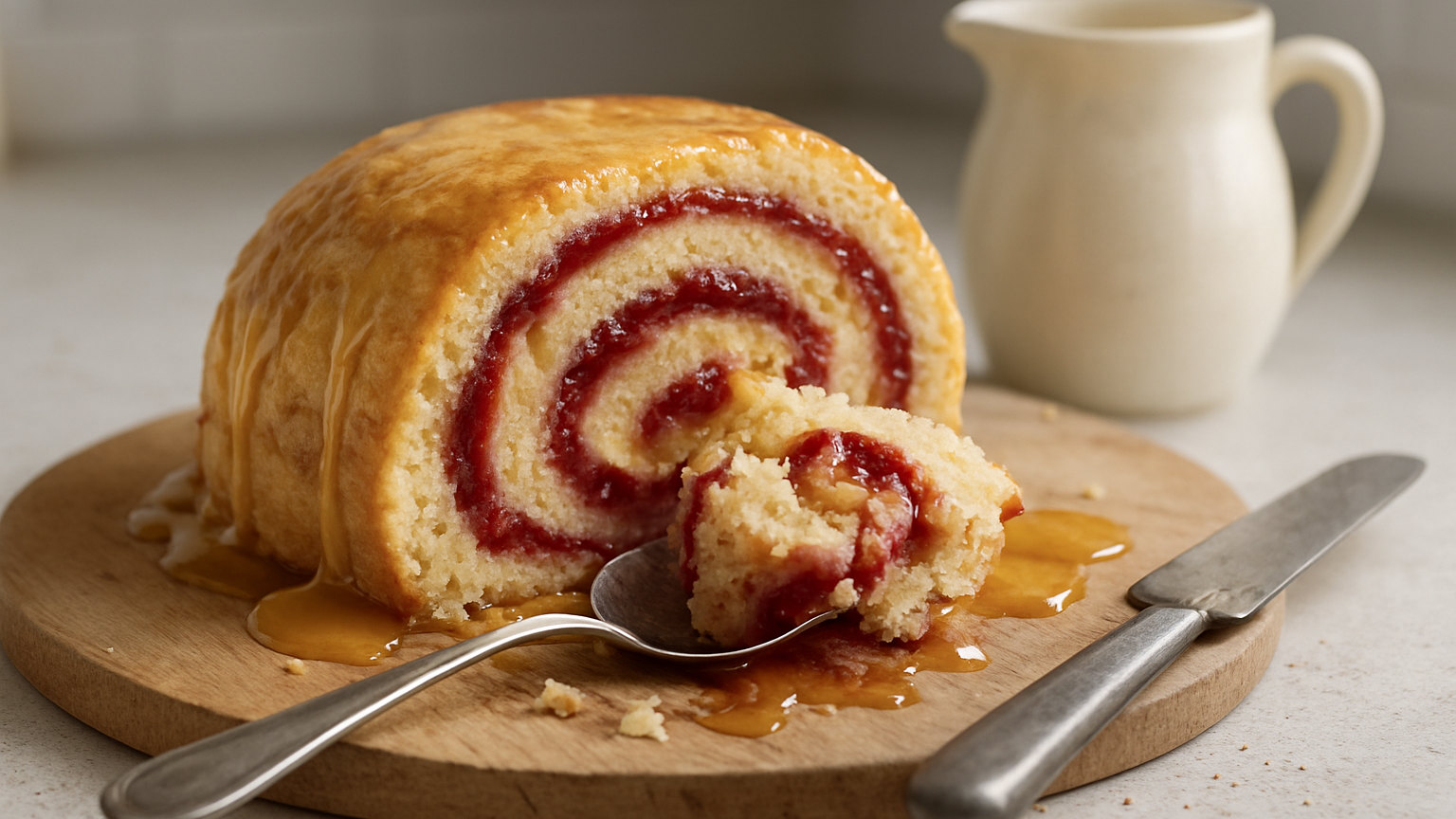
Jam roly-poly is a suet crust spread with jam, rolled into a log and steamed until the pastry is soft and the jam has bubbled through it in a spiral. Cut into thick rounds and served with custard, it is one of the defining British nursery puddings. It takes fifteen minutes to assemble and then looks after itself in the steamer.
Why is it called dead man's arm?
The pudding was traditionally steamed inside an old shirt sleeve, which gave it a cylindrical shape and a rather grim appearance when unwrapped. The nickname stuck and is still widely used, particularly in schools. Modern recipes use pleated baking paper and foil instead, which is considerably more hygienic and works just as well.
What ingredients do you need?
Serves 6.
- 250g self-raising flour
- 125g shredded suet, beef or vegetable
- 50g caster sugar
- A pinch of fine salt
- About 150ml cold water
- 6 tbsp raspberry jam
- 2 tbsp milk, for brushing
How do you make jam roly-poly?
- Mix the flour, suet, sugar and salt, then add enough cold water to make a soft but firm dough.
- Roll out on a floured surface into a rectangle about 30 by 22cm.
- Warm the jam slightly and spread it over the dough, leaving a clear 2cm border all round.
- Brush the border with milk.
- Roll up from the short side, not too tightly, and pinch the ends closed.
- Lay on a large sheet of pleated baking paper, wrap loosely, then wrap in pleated foil and twist the ends like a cracker.
- Steam over simmering water for one hour 30 minutes, topping up with boiling water as needed.
- Unwrap carefully and cut into thick slices.
Wrap it loosely with a pleat: the roll expands considerably as it steams. Wrapped tightly, it splits along its length and the jam escapes into the water.
Why leave a border around the jam?
Jam spread right to the edge stops the seam sealing, so the roll comes apart during steaming and the filling leaks out. A clear 2cm border, brushed with milk, gives the dough something to stick to. The same applies to the ends, which should be pinched firmly closed.
Why roll it loosely?
A tightly rolled pudding has nowhere to expand as the suet crust rises, so it bursts. Rolling loosely leaves small gaps between the layers that fill out during cooking, giving the soft spiral you want when it is sliced. It feels wrong while you are doing it and is correct.
Can you bake it instead?
Yes. Place the wrapped roll on a baking tray and bake at 180°C (160°C fan), gas 4, for about 40 minutes, unwrapping for the last 10 minutes to brown the outside. Baked, the crust is firmer and slightly crisp rather than soft and steamed. Both versions are traditional.
What jam should you use?
Raspberry is the classic, and its sharpness cuts the richness of the suet crust. Strawberry, blackcurrant and plum all work. Use a thick, well-set jam rather than a runny one, which escapes more easily. Warm it only slightly, just enough to spread without tearing the dough.
How long does it keep?
It keeps for two days in the fridge and reheats by steaming for 20 minutes. It freezes for three months, wrapped. Serve it hot in thick slices with a great deal of custard, which is not optional as far as most people are concerned.
How do you stop the jam escaping?
Beyond the border and the loose roll, do not overfill it. Six tablespoons is plenty for this quantity of dough, and adding more simply guarantees leakage. Pinching the ends firmly closed and twisting the foil like a cracker also helps keep everything where it should be.
Can you make it in a basin instead?
You can, though it is no longer a roly-poly. Coil the rolled log into a greased basin, cover and steam for two hours. This gives a spiral pudding that turns out as a dome. It is easier to handle than a wrapped roll and useful if you have no large steamer.


