
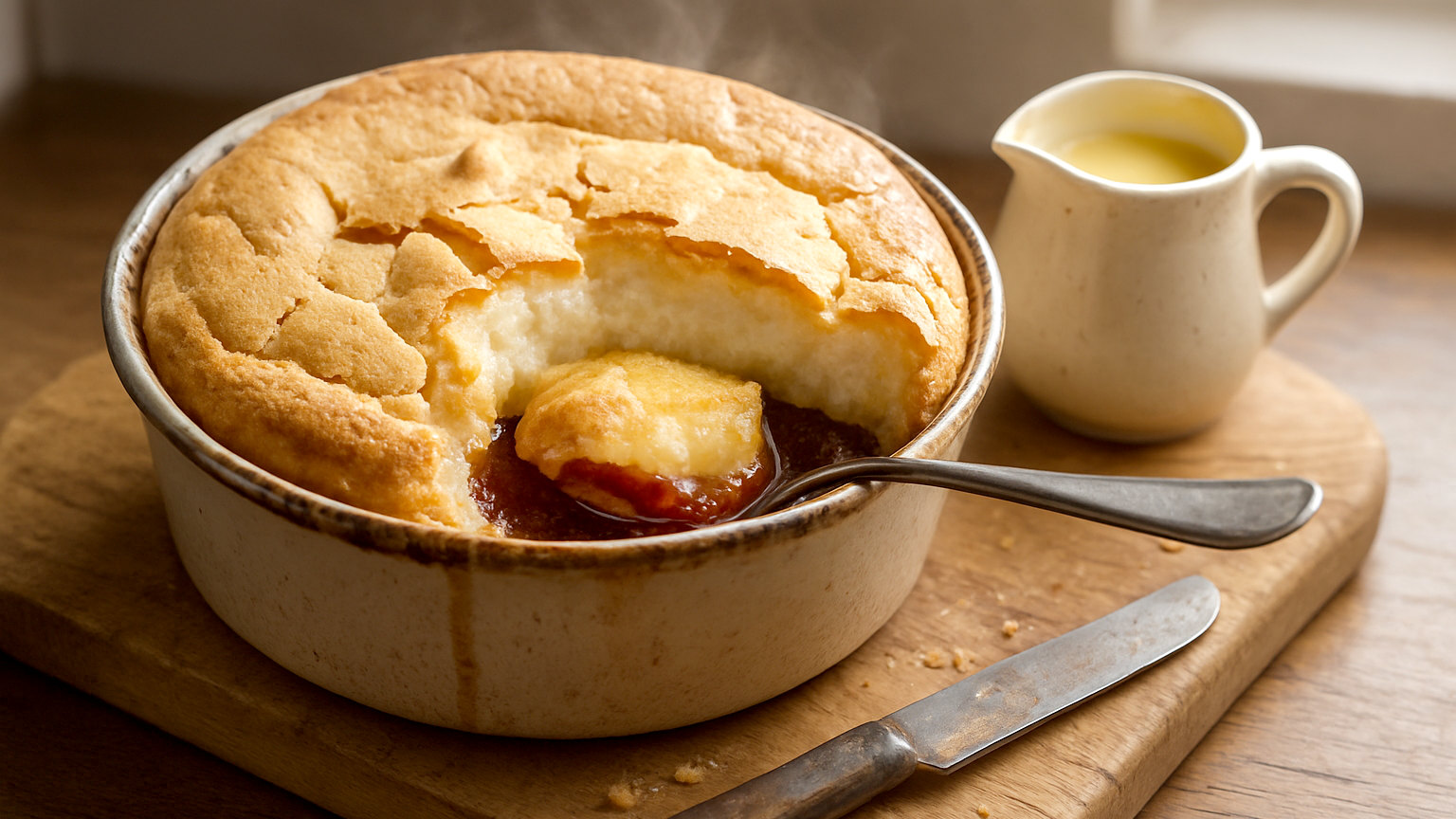
Manchester pudding is a Victorian dish of jam spread in a dish, covered with a lemon-scented breadcrumb custard and topped with meringue. It is closely related to queen of puddings, and it is the direct ancestor of the Manchester tart, which swaps the meringue for coconut and adds a pastry case. It is thrifty, gently flavoured and quietly excellent.
How does it relate to the Manchester tart?
The tart came later and simplified the pudding. A Manchester tart has a shortcrust pastry case, a layer of raspberry jam, a thick custard filling and a scattering of desiccated coconut, usually with a glacé cherry. The pudding has no pastry, uses a breadcrumb-thickened custard rather than a cornflour one, and is finished with meringue instead of coconut.
What ingredients do you need?
Serves 6.
For the base
- 600ml whole milk
- Pared zest of 1 lemon
- 100g fresh white breadcrumbs
- 50g caster sugar
- 50g unsalted butter
- 4 large egg yolks
- 1 tbsp brandy, optional
For the layers
- 5 tbsp raspberry jam
- 4 large egg whites
- 200g caster sugar
How do you make Manchester pudding?
- Heat the milk with the pared lemon zest until steaming, then leave to infuse for 20 minutes and remove the zest.
- Heat the oven to 170°C (150°C fan), gas 3. Grease a 1.5 litre baking dish.
- Spread the raspberry jam over the base of the dish.
- Reheat the milk, pour it over the breadcrumbs with the caster sugar and butter, and leave for 15 minutes.
- Beat in the egg yolks and the brandy, if using.
- Pour gently over the jam, using the back of a spoon to avoid disturbing it.
- Bake for 30 minutes, until just set with a slight wobble.
- Whisk the egg whites to soft peaks, add the sugar gradually and whisk to stiff, glossy peaks.
- Spoon over the custard, spreading to the edges, and bake for another 15 to 20 minutes until golden.
Pour the custard over the back of a spoon: poured straight in, it churns the jam up into the custard and you lose the distinct layer at the bottom.
Why is brandy traditional?
Victorian recipes for Manchester pudding frequently include a spoonful of brandy in the custard, which was a common way of enriching an otherwise plain nursery dish. It is entirely optional, and the pudding is very good without it. If you include it, remember the alcohol is not fully cooked off, so mention it to guests.
Why infuse the milk with lemon?
Steeping pared lemon zest in warm milk draws the fragrant oils out of the skin without adding any bitterness from the pith or any acidity from the juice. It gives a gentle, rounded citrus flavour through the whole custard. Removing the strips afterwards keeps the texture smooth.
Can you use a different jam?
Raspberry is traditional, and its sharpness cuts the sweet meringue. Strawberry, apricot and blackcurrant all work well. Some old recipes use a layer of candied peel alongside the jam. Whatever you choose, spread it in an even layer so every portion gets some.
Why use fresh breadcrumbs?
Fresh white breadcrumbs, made from day-old bread blitzed in a processor, swell and soften into the milk to give the custard its characteristic soft body. Dried or packaged crumbs stay hard and gritty. It is worth making your own, and any leftovers freeze well for another pudding.
How long does it keep?
It is best served warm on the day it is made. Leftovers keep in the fridge for two days, though the meringue softens and weeps a little. It does not freeze. Serve it on its own or with a jug of cream.
Can you make it without meringue?
Yes, and it becomes closer to a plain baked breadcrumb custard, which is very good in its own right. Bake the base for the full 45 minutes until set and golden, and serve it with extra jam warmed and spooned over. Some Victorian versions were finished with a lattice of pastry strips instead.


