
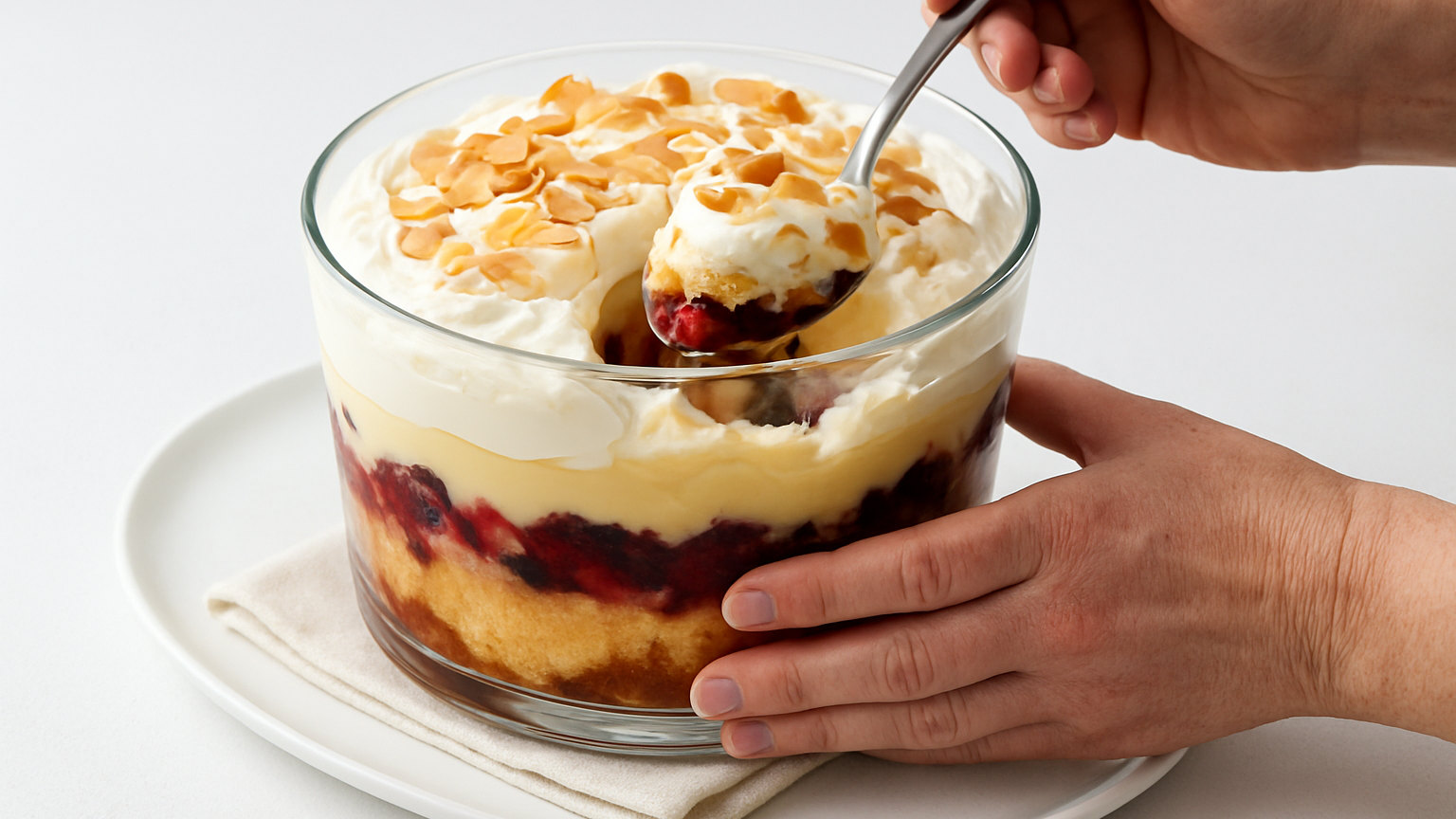
A trifle looks good because of its layers, and the layers survive for one reason: each is cold and set before the next goes on. Build it in a hurry, with warm custard or unset jelly, and everything merges into a single brown mixture that tastes fine and looks like nothing at all. The whole technique is patience, applied four times.
What order do the layers go in?
| Order | Layer | Must be |
|---|---|---|
| 1 | Sponge, jam and soaking liquid | Fully absorbed, 20 minutes |
| 2 | Fruit | Cold, drained of excess juice |
| 3 | Jelly, if using | Cooled, then set firm |
| 4 | Custard | Cold and thick, chilled 2 hours |
| 5 | Whipped cream | Soft peaks, chilled overnight |
| 6 | Decoration | Added just before serving |
Why must each layer be cold?
Heat is what destroys a trifle. Warm custard melts into the sponge below and thins the cream above. Warm jelly collapses the sponge and soaks into the fruit. Every layer should be at fridge temperature before it meets the next one, and the bowl should go back into the fridge between each stage.
Never pour warm jelly onto sponge: it soaks straight through, the sponge disintegrates, and you end up with a brown sludge at the bottom of the bowl. Cool it to room temperature first.
How long between layers?
Twenty minutes for the sponge to absorb its liquid. Two to four hours for jelly to set firm. Two hours for the custard to firm up. Then overnight once the cream is on, which lets the whole thing settle. A trifle assembled in a rush and served an hour later will taste good and look poor.
What bowl should you use?
A straight-sided glass bowl of around three litres, so the layers are visible and even. Straight sides give neat bands; a curved bowl makes the layers look uneven from outside. Clear glass matters more than anything else, since the appearance of the layers is the point of building it this way.
How do you get clean edges against the glass?
Spread each layer right to the edge of the bowl with the back of a spoon, sealing it against the glass. Press a few pieces of fruit deliberately against the side so they show. Wipe any smears from the inside of the bowl with kitchen paper on a skewer before adding the next layer.
Why is my custard sinking into the sponge?
It was too thin, too warm, or both. Trifle custard must be thickened with cornflour as well as egg yolks and boiled properly, so it sets almost firm when cold. Spoon it on gently rather than pouring it, and make sure the sponge layer has already absorbed all its liquid.
How do you stop the cream weeping?
Whip it only to soft peaks, which hold their shape without the fat separating. Over-whipped cream looks grainy and releases liquid within hours. A tablespoon of icing sugar helps stabilise it, and mascarpone folded in at a ratio of one part to four gives a cream that holds for two days.
How far ahead should you make it?
The day before is ideal. A trifle genuinely improves overnight, as the sponge softens fully and the flavours settle into one another. Add anything crisp, such as toasted almonds, chocolate curls or fresh fruit, only in the last few minutes before it goes to the table.
Do you have to include jelly?
No, and it divides opinion sharply. The older tradition uses sherry-soaked sponge with no jelly at all, and many people consider jelly a twentieth-century intrusion. Others regard a trifle without it as incomplete. If you do use it, it must be cooled before pouring and fully set before the custard goes on.
What sponge works best?
Shop-bought trifle sponges exist precisely for this, being slightly dry and designed to absorb liquid without collapsing. A plain Victoria sponge, Madeira cake, sponge fingers or leftover Swiss roll all work. Avoid rich, buttery or iced cakes, which turn greasy and oversweet once soaked.


